Rooftop Gardens and Green Walls
Rooftop gardens, podium landscaping and green walls have become standard in new Ho Chi Minh City developments, and they make buildings considerably more pleasant to live in.
They also introduce soil, permanent irrigation, organic matter and continuous shelter to parts of a building that previously had none of those. That is not an argument against them; it is an argument for designing and maintaining them with this in mind.
What planting brings with it
Soil supports ant nesting, and mature plants arrive from a nursery with whatever was living in the root ball. Irrigation keeps that soil permanently moist regardless of season, which removes the dry period that would otherwise limit populations.
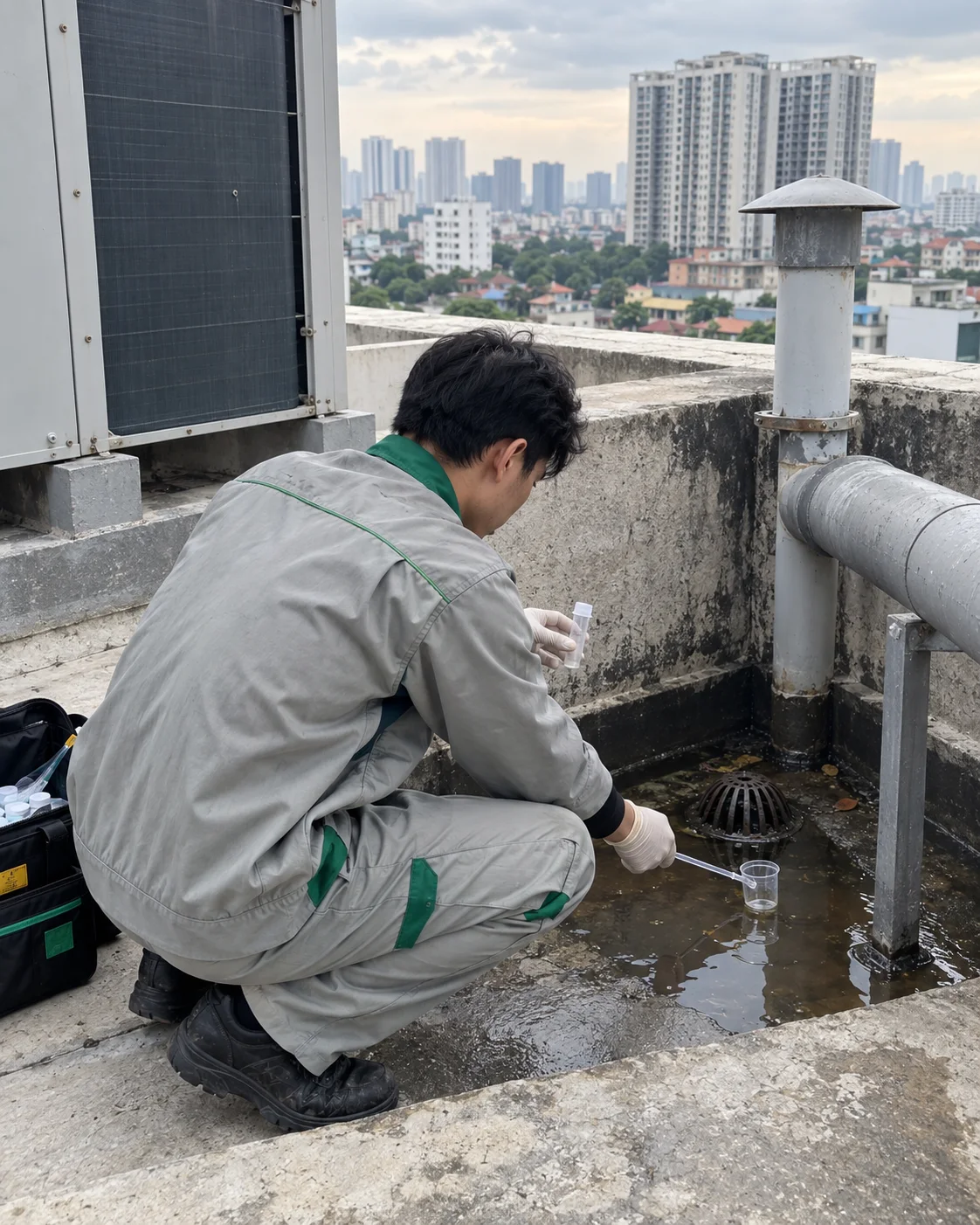
Drip trays, saucers, blocked drainage layers and irrigation reservoirs all hold standing water. In a city where the mosquito that matters breeds in small clean containers, a planted terrace is a collection of them.
Green walls specifically
A vertical planting system holds soil or substrate directly against the building envelope, at every level, permanently irrigated and permanently shaded behind the foliage. It is continuous, it is unreachable once established, and nobody inspects the surface behind it.
The consequences are ants nesting in the substrate with direct access to windows, moisture held against the wall, and a sheltered vertical route. Where a green wall runs past openable windows, the route from the planting into the apartment is a few centimetres.
Design decisions that matter
A clear strip of 30 to 50 cm between planting beds and any building wall, at every level. Drainage layers that actually drain and can be rodded. Irrigation on a controller with a soil moisture sensor rather than a fixed schedule, so beds are not watered through the rainy season. And no planting bed built directly against a window opening.
For a green wall, a genuine ventilated cavity between the planting system and the building envelope, and access panels so the wall behind can be inspected. Systems installed hard against the structure with no access are the ones that cause problems.
Maintenance that matters more than design
Clear fallen leaf litter rather than letting it accumulate in bed corners. Keep drainage outlets clear, because a blocked drainage layer turns a bed into a reservoir. Check trays and reservoirs weekly during the rainy season. And prune anything touching the building, since a branch resting on a facade is a bridge.
Most green wall problems we see are maintenance rather than design, and the maintenance contract is usually written for appearance rather than for drainage.
What lives there, and what of it matters
Ants, in the substrate, and they are the most common complaint. Mosquitoes, from any standing water. Spiders and geckos, which follow the insects and are largely benign. Occasionally rodents, where planting is dense enough to provide cover next to a food source.
Snails, caterpillars and aphids are horticultural problems rather than pest control ones, and they are the gardener\x27s department. It is worth having that boundary clear, because a landscaping contractor and a pest contractor otherwise each assume the other is handling it.
Treating a planted area
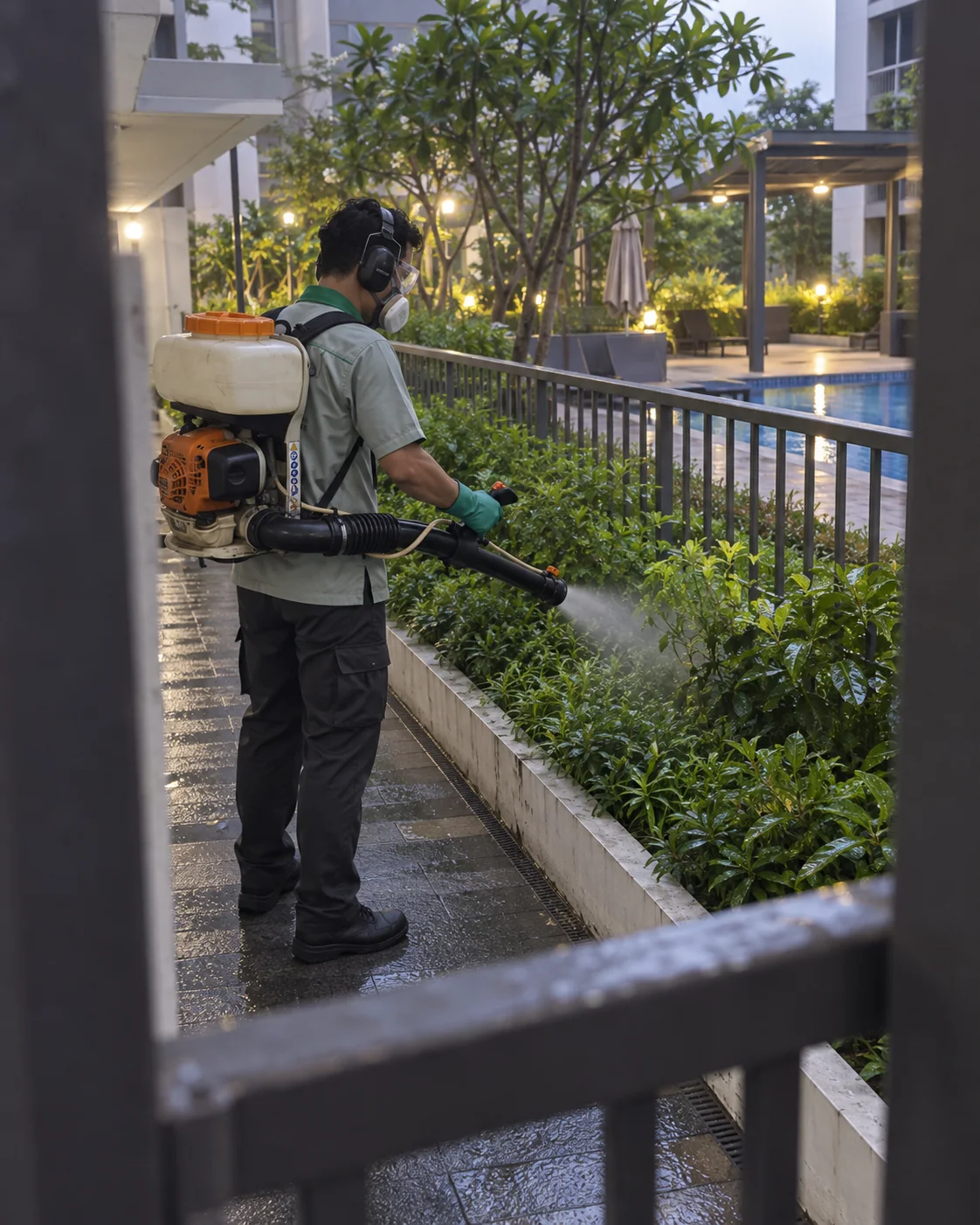
With restraint. Broad-spectrum treatment of a garden kills the predatory and pollinating insects that keep the planting healthy, and it produces a worse horticultural outcome as well as a temporary pest one.
Targeted ant baiting at the nest, container reduction, larviciding where water genuinely cannot be removed, and drainage correction do the work. A monthly blanket spray of a podium garden is the version to avoid.
For residents with a planted balcony
The same principles at a small scale. Fill saucers with sand, drill decorative outer pots, keep the soil surface clear of leaf litter, water on demand rather than on a timer, and keep at least a small gap between pots and the wall. It is a five-minute weekly routine and it removes almost all of the consequences while keeping the plants.
Related reading
See balcony planters and why ground floor units have more problems. For water, swimming pools and water features and breeding sites around your home. Ants are covered in reading an ant trail. Our parent company covers landscaped sites in Vietnamese through its ant control programme.
Global Pest Control is the English-language arm of Khử Trùng Toàn Cầu, based in Thu Duc City.
Common questions
Should our building remove the green wall?
Almost never, and it is rarely the proportionate answer. What is usually needed is access for inspection, a working drainage layer, irrigation that responds to soil moisture rather than a clock, and a maintenance specification that includes clearing litter and checking outlets. Removing a green wall solves a problem that maintenance would have solved.
Ants keep coming in from the podium garden. What works?
Bait at the nest rather than treatment of the trail, plus a clear strip between the bed and the wall, plus sealing the specific entry into your unit. Spraying the garden scatters the colony and it will re-form. This is a case where the slower approach is markedly faster in practice.
Is it safe to treat a garden where children play?
It depends entirely on the method, which is the honest answer. Bait placed at a nest and secured, and larvicide in standing water, involve no accessible residue. Broadcast spraying of a lawn or a play surface is a different matter and we would not do it in a children\x27s area. Ask specifically what will be applied and where, rather than whether it is safe.