Termite Swarms After the First Rains: What They Mean
For a few evenings after the first heavy rains, usually in April or May, hundreds of winged insects gather around outdoor lights and then find their way inside. By morning there are discarded wings on the windowsill and a few dead insects on the floor. Those insects are termite reproductives, and they are harmless in themselves — most die within hours.
The swarm still matters, because a colony only produces reproductives once it is mature. A swarm is evidence that an established colony is close by.
Termite or flying ant?
Both swarm after rain and both are often called "flying ants". Three differences settle it, and you can check them on a dead specimen with the naked eye:
- Waist: a termite has a straight, thick body with no narrow waist; an ant has an obvious pinch between thorax and abdomen
- Wings: a termite has four wings of equal length, all longer than the body; an ant has a longer front pair and a shorter rear pair
- Antennae: a termite's are straight and bead-like; an ant's are elbowed
The distinction is worth two minutes because the response is completely different. Flying ants indicate an ant colony, which is usually a nuisance. Termites indicate a colony that eats structural timber, door frames, skirting and anything cellulose in storage.
Where the wings are is the useful clue
Swarmers are drawn to light and will fly in through an open window from a colony in a neighbouring garden. That is common and does not by itself mean your building is infested.
What changes the picture is finding wings in places outside air could not reach: inside a wardrobe, in a closed store room, along an internal corridor, on the floor of a room with sealed windows. Wings in those places suggest the reproductives emerged inside the building, which means the colony is inside too.
What to look for after a swarm
- Mud tubes the width of a pencil running up walls, columns or the outside of foundations
- Skirting or door frames that sound hollow when tapped
- Paint that looks blistered or rippled over a small area
- Timber that is soft when pressed with a screwdriver but intact on the surface
- Piles of wings in enclosed interior spaces
What not to do
Do not spray the mud tubes or break them open and treat with an aerosol. Subterranean termites respond to disturbance by abandoning that route and building elsewhere, often somewhere you cannot see. The infestation continues, and the only thing that has changed is that you can no longer follow it.
The same applies to over-the-counter powders applied to visible workers. They kill what is in front of you and leave the colony, which is the part that matters.
What a proper response looks like
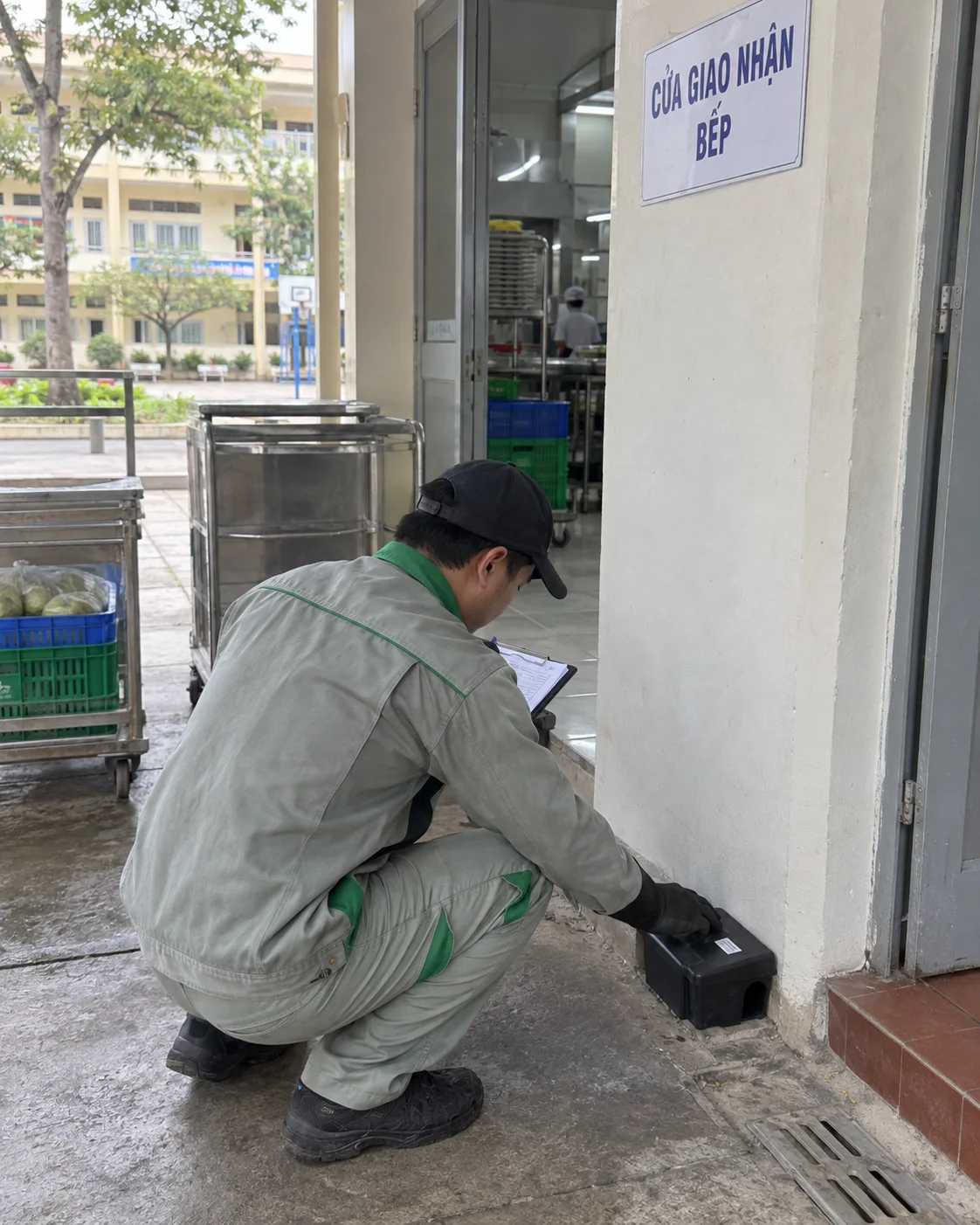
A termite inspection maps the moisture sources, the soil contact points and the routes into the structure, then treats along those routes — either with a soil barrier or with bait stations that the colony carries back itself. Both take time to work. Neither is a single afternoon with a sprayer.
For a building with wooden floors, built-in joinery or stored documents, the cost of an inspection after a swarm is small compared with the cost of finding out two years later.
What happens to the swarmers that get inside
Almost all of them die. A swarming flight is a mass release in which the great majority of individuals are lost, and a pair only survives if it lands somewhere with soil contact and moisture. Inside a tiled apartment on the fifteenth floor there is nowhere for them to go.
That is worth knowing because the sight of hundreds of insects suggests an emergency and usually is not one. Sweep them up, and treat the event as information rather than an infestation in itself.
Which buildings are actually at risk
- Ground and first floors, where soil contact is possible
- Buildings with planters, courtyards or light wells against structural walls
- Older structures with timber in contact with masonry
- Anywhere with a persistent leak or damp patch near timber
- Buildings adjacent to recently excavated ground
A high-floor apartment with no timber structure and no planters is at very low risk even in a building where the ground floor has termites. Risk here is about soil, moisture and timber, not about height alone.
What an inspection after a swarm involves
A technician checks the perimeter for mud tubes, looks at every point where timber meets masonry or soil, sounds skirting and door frames, checks under sinks and around water heaters for moisture, and looks at any planter or courtyard against the building.
For an apartment that takes half an hour. For a house with a garden it takes longer and is worth doing properly, because the useful output is a map of the routes rather than a yes or no answer.
Global Pest Control is the English-language arm of Khử Trùng Toàn Cầu. The same technicians and the same programmes are described in Vietnamese on the company site, khutrungtoancau.vn.
Book an inspection
Site inspections are free of charge and carry no obligation. A technician walks the property, identifies the species and the harbourage, and sends a written quotation with the method and the schedule — normally within one working day.
Request an inspection · See indicative prices · All services