Balcony Planters and What Collects Underneath
Mosquito control in an apartment is often discussed as if the mosquitoes come from somewhere else — the canal, the empty lot, the building next door. Sometimes they do. Very often they come from a saucer under a pot on your own balcony, which is the closest breeding site to your bedroom that could possibly exist.
The species that matters here, Aedes aegypti, needs clean standing water rather than dirty water, breeds in containers rather than in ground pools, and completes a generation in about seven to ten days in this climate. A drip saucer meets every one of those requirements.
What counts as a breeding site on a balcony
- Drip saucers under pots, including the shallow ones that look like they hold nothing.
- Self-watering planters with a reservoir, which are designed to hold water permanently.
- Decorative pots with no drainage hole used as an outer sleeve around a plastic pot.
- The folds of a tarpaulin, an unused bucket, a watering can, a bike cover, the tray under an air-conditioning outdoor unit.
What does not count: soil that is merely damp, a pot that drains freely onto the floor, or a floor that is wet after rain and dries within a day.
The seven-day rule
Because the cycle from egg to adult takes roughly a week here, anything that holds water for less than seven days produces nothing. That is a more useful rule than trying to eliminate water entirely, and it makes the task manageable: empty and wipe the saucers weekly, and the balcony stops producing mosquitoes regardless of how many plants you have.
Wiping matters as much as emptying. Aedes eggs are laid on the wall of the container just above the water line and survive drying for months, hatching when the container refills. Tipping the water out and leaving the saucer dry does not remove them; a wipe with a cloth does.
What to change, and what to keep
You do not need to give up plants. Fill saucers with sand so they still catch drips but hold no open water, or remove them entirely and accept that the floor gets wet. Replace self-watering planters with conventional ones for anything on a balcony. Store buckets and watering cans upside down. Drill a drainage hole in decorative outer pots.
The one thing genuinely worth removing is any ornamental water feature without a pump or fish, which is a purpose-built breeding site.
The air-conditioning tray
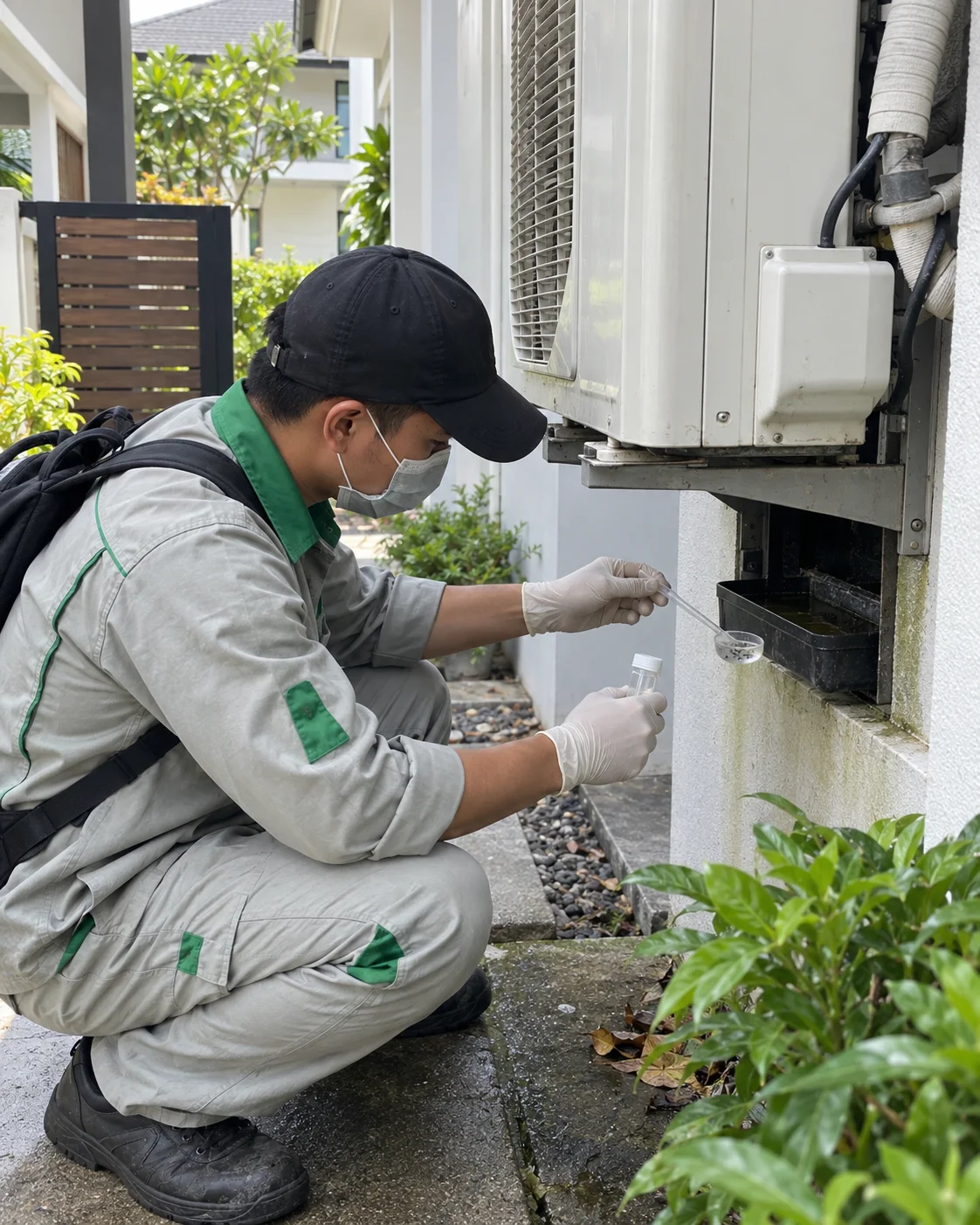
Almost every apartment has an outdoor condenser unit on the balcony or in a service void, and many sit in a shallow tray or on a bracket that collects condensate. That water is clean, sheltered and permanent, and it is checked by nobody. When we survey a balcony with a persistent mosquito problem and the saucers are clean, this is where we look next.
Why your neighbour matters
An Aedes mosquito typically stays within about 100 metres of where it emerged, which in a vertical building means the flat above, below and either side of you are firmly within range. This is the reason a well-managed balcony can still have mosquitoes, and it is also the reason building-wide action works so much better than individual action. If your building has a management committee, container reduction across all balconies and the common areas is a far cheaper intervention than fogging.
Fogging, and why we are cautious about it
Space spraying kills adult mosquitoes present at the moment of treatment and has essentially no residual effect. If breeding sites remain, adult numbers return within one to two weeks. It has a place during an outbreak, where the point is to break transmission quickly, and it is close to useless as a routine measure. When a building fogs monthly and the residents still complain, this is why.
Related reading
For the wider picture see mosquito breeding sites around your home and our mosquito guide. Building-level water storage is covered in rooftop water tanks, and the seasonal pattern in the pest year in Ho Chi Minh City. The household programme is our apartment programme. Our parent company runs the Vietnamese-language mosquito control programme.
Global Pest Control is the English-language arm of Khử Trùng Toàn Cầu, based in Thu Duc City.
Common questions
Do mosquito-repelling plants work?
Citronella, lemongrass and basil contain compounds that repel mosquitoes when the oil is extracted and applied to skin. A living plant on a balcony releases almost none of that into the air and has no measurable effect on how many mosquitoes are present. Crushing a leaf and rubbing it on your arm does something; the plant sitting in a pot does not.
I am on the fifteenth floor. Should I still worry?
Yes. Aedes are weak fliers, but they do not need to fly up — they breed on the balcony they are already on, and they travel between floors in lifts and stairwells. High-floor apartments with balcony planters report mosquitoes at close to the same rate as low ones.
Is there anything I can put in the water instead of emptying it?
For a container you genuinely cannot empty, such as a large ornamental pot, a Bti larvicide is specific to mosquito larvae and lasts several weeks, and it is never used in water for drinking or washing. It is not something to use routinely on a drip saucer, where emptying is simply easier and free.