Termite Control in Vietnam: How We Treat Homes and Buildings
Quick answer. In southern Vietnam, most termite damage comes from subterranean termites. They live in the soil and reach wood through mud tubes on walls, floors and door frames. For a building already in use, we set bait stations where termites are active and check them over 7 to 14 days. Then we apply a transfer product that the workers carry back to the colony, and dust the mud tubes. For new construction, we treat the foundation surface at 3–5 litres per square metre before the slab is poured. We do not drill walls or floors, and we do not fumigate buildings.
Signs of termites
- Mud tubes about the width of a pencil, running up walls, along skirting or inside cupboards.
- Hollow-sounding wood in door frames, skirting and built-in furniture.
- Swarms of winged termites after the first heavy rains, usually April–May, with discarded wings on window sills.
- Small piles of pellets under furniture, a sign of drywood termites in that piece.
Do not break the tubes or spray them before the survey. Photograph them and leave them in place; they show the technician where the colony is feeding.
How treatment works
- Survey: we trace the tubes and damaged wood, and mark where termites are active.
- Bait stations: stations go where termites are feeding and are checked over 7 to 14 days.
- Transfer treatment: once termites are feeding at the stations, we apply a product the workers carry back to the colony, so the whole colony is reached, not only the termites you see. We also apply a fine dust along the mud tubes.
- Follow-up: we check the stations and tubes until activity stops, then advise on the moisture and wood-to-soil contact that invited them in.
The timeline is weeks, not days, because the treatment has to be carried back and spread through the colony.
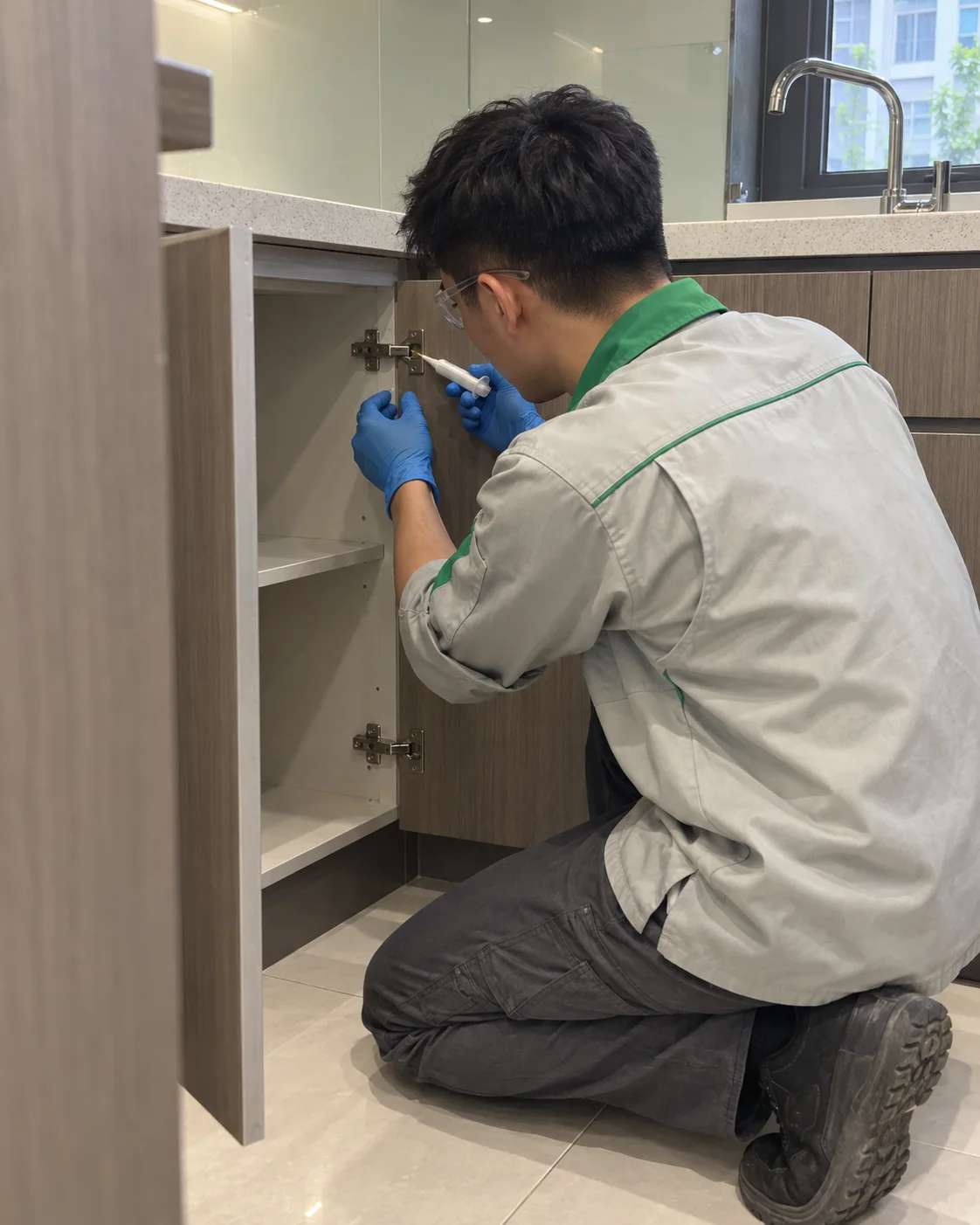
Drywood termites in furniture
When one cabinet, door frame or piece of furniture is infested, we treat that item locally. We tell you honestly when replacing it is cheaper.
New construction
For a building under construction, we treat the prepared foundation surface at 3–5 litres per square metre before the slab is poured, in line with Vietnamese standard TCVN 7958:2017 for termite prevention in construction.
Termites are a separate service
Termite work is quoted and contracted on its own. It is not part of a monthly general pest control programme, because the method, the products and the timeline are different. Prices are on the price list.
What you receive
- A plan of where the stations are and where activity was found.
- A written report after each check: stations with activity, tubes treated, and what has changed.
- A list of the conditions that invited termites in: leaking pipes, wood touching soil, planters built against walls, damp under floors. Fixing these is what stops the next colony from finding the same route.
If termites come back to the treated area within the agreed period, we come back and treat again.
Buying or renting a house
If you are moving into a villa or townhouse, a termite inspection before you sign is worth the small cost. Termite damage in door frames and built-in furniture is often invisible until it is serious. Ask us for an inspection report you can show the landlord.
Common questions
Can I spray the tubes myself?
Please do not. Spraying makes the termites move away from that route, and the colony keeps feeding elsewhere in the building.
Do you drill holes along the walls?
No. We work with bait stations, the transfer treatment and dust on the tubes.