Party Walls and Roof Junctions in Terraced Housing
The nhà phố — the narrow townhouse or shophouse — is the characteristic Vietnamese urban building, typically four metres wide, several storeys tall, and sharing a wall on each side with the house next door.
Those shared walls, and the roof junctions above them, are the reason a well-managed townhouse can have a problem that originates entirely next door.
What a party wall actually is
In many of these buildings the wall is genuinely shared, built once and used by both houses. In others there are two separate walls with a narrow gap between them, which is worse — that cavity is continuous, unreachable, and is a harbourage and a route for the full height of both buildings.
Which of the two you have determines quite a lot, and it is worth finding out. A cavity between two houses is a space nobody can inspect, treat or clean.
The roof junction
Where two roofs meet at different heights or with different construction, there is almost always a gap. Roof rats use these junctions as their principal route between buildings, and in a row of townhouses the roofline is effectively a continuous path along the whole terrace.
That is why noise in a top-floor ceiling in a townhouse is such a common complaint, and why it frequently affects several houses in a row at once.
What crosses, and what does not
Rodents cross readily, through roof junctions, cavity walls and any service penetration. Cockroaches cross through drainage connections and through gaps around pipes. Ants cross wherever there is a continuous surface. Termites cross underground, because a colony in the soil does not recognise a boundary at all.
Bed bugs cross far less often, because they follow people rather than structure. Mosquitoes are not a wall question at all — they are a container question, and the containers are on both properties.
What you can achieve alone
More than you would expect. Seal every penetration on your side of the party wall — pipe entries, cable holes, air-conditioning wall penetrations, the gap where a beam enters. Close the roof junction on your side where it is accessible. Fit brush strips to doors, seal the front threshold, and keep the drains sealed.
That converts your house from part of a continuous structure into a defended one. It does not remove the population next door, and it stops it from being your population.
When you have to talk to the neighbour
For termites, always, because the colony is in shared soil and a treatment on one side of a boundary gives a partial result. For a substantial rodent population, usually, because the harbourage may be under their floor rather than yours.
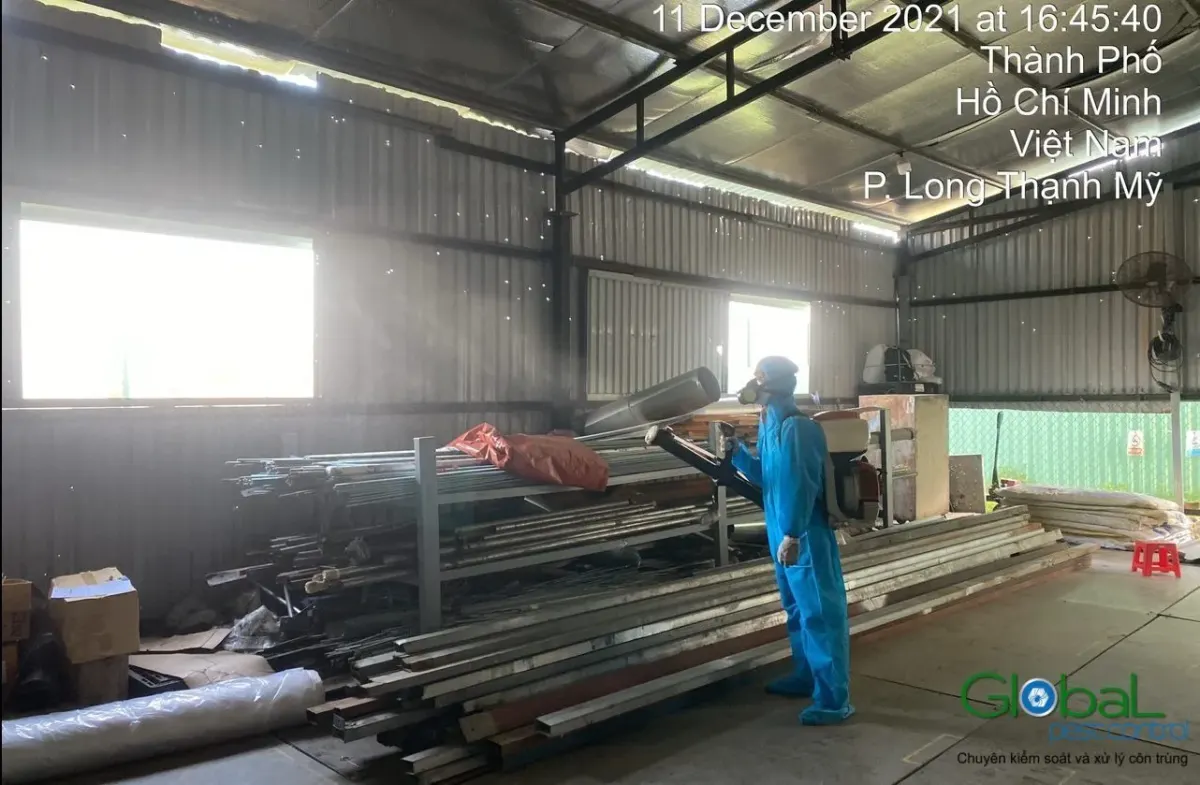
A joint treatment of two or three adjacent houses is normally cheaper per house than separate ones and considerably more effective. In our experience neighbours agree to this more readily than people expect, particularly when the approach is a shared quotation rather than a complaint.
The mixed-use complication
Many townhouses have a business on the ground floor and a residence above, and often the business belongs to a different household. A restaurant, a bakery or a grocery on the ground floor of your building changes the pest profile of every floor above it, because it introduces a continuous food source, grease in the drainage and a delivery route.
Where you live above a business you do not control, sealing the internal staircase route and the floor penetrations between the two is the highest-value work available.
The rear yard and the light well
Most townhouses have a small rear yard or an internal light well, and these are where the drainage, the water tank, the outdoor units and usually the bins all end up. They are also narrow, shaded and rarely cleaned. In a survey of a townhouse this is the area that most often explains the problem, and it is the area residents think about least.
Related reading
See older buildings and shophouses and treating one property in a dense alley. For termites, mud tubes. On sealing, physical proofing, and for the rodents involved, rats and mice compared. Our parent company runs the Vietnamese-language residential programme for townhouses.
Global Pest Control is the English-language arm of Khử Trùng Toàn Cầu. We can approach a neighbour in Vietnamese on your behalf if a joint treatment is the sensible answer.
Common questions
My neighbour will not do anything. Is my treatment wasted?
No, but expect a different outcome. Treating and sealing your own house reduces the population inside it and closes the routes, which usually means occasional individuals rather than an established problem. What it will not do is stop pressure from next door, so the programme becomes ongoing exclusion rather than a one-off resolution.
Can I seal a shared wall without permission?
Sealing penetrations on your own side is work inside your property and does not normally require anyone\x27s agreement. Anything that alters the shared wall itself, or that involves working from the neighbour\x27s side, does. In practice almost everything worth doing is on your own side.
We are buying a townhouse. What should we check?
Whether the party walls are shared or cavity, the condition of the roof junctions on both sides, the rear yard drainage, and whether there is a food business in the building or immediately adjacent. Also a termite inspection, since these are ground-contact buildings and damage is slow and hidden.