Living Above a Restaurant or Cafe: What to Expect
An apartment above a restaurant or cafe is usually cheaper, better located and noisier than the equivalent elsewhere. It also shares three things with the business below that matter for pests: the drainage stack, the refuse area and, in many buildings, a ceiling void.
None of those three is improved by treating your own kitchen, which is why residents in this situation often feel that treatment does not work.
The drainage stack
A commercial kitchen puts far more grease and organic material into the drainage than a household does. That builds a food supply inside the pipework, and American cockroaches live in it. They travel up the stack and emerge through floor gullies and through the gaps around waste pipes under sinks.
The two things that stop this are within your control: keep every floor gully filled with water so the trap seals, and seal the annular gap where waste pipes pass through the floor or wall inside cabinets.
The refuse area
Food businesses generate waste in volume and often store it outside the back door until collection. If your entrance, stairwell or window is near that point, it is the single largest attractant in the building.
What is reasonable to ask for is closed bins, collection at a stated frequency, and the area washed down. Those are ordinary requirements for a food business, not favours.
The ceiling void
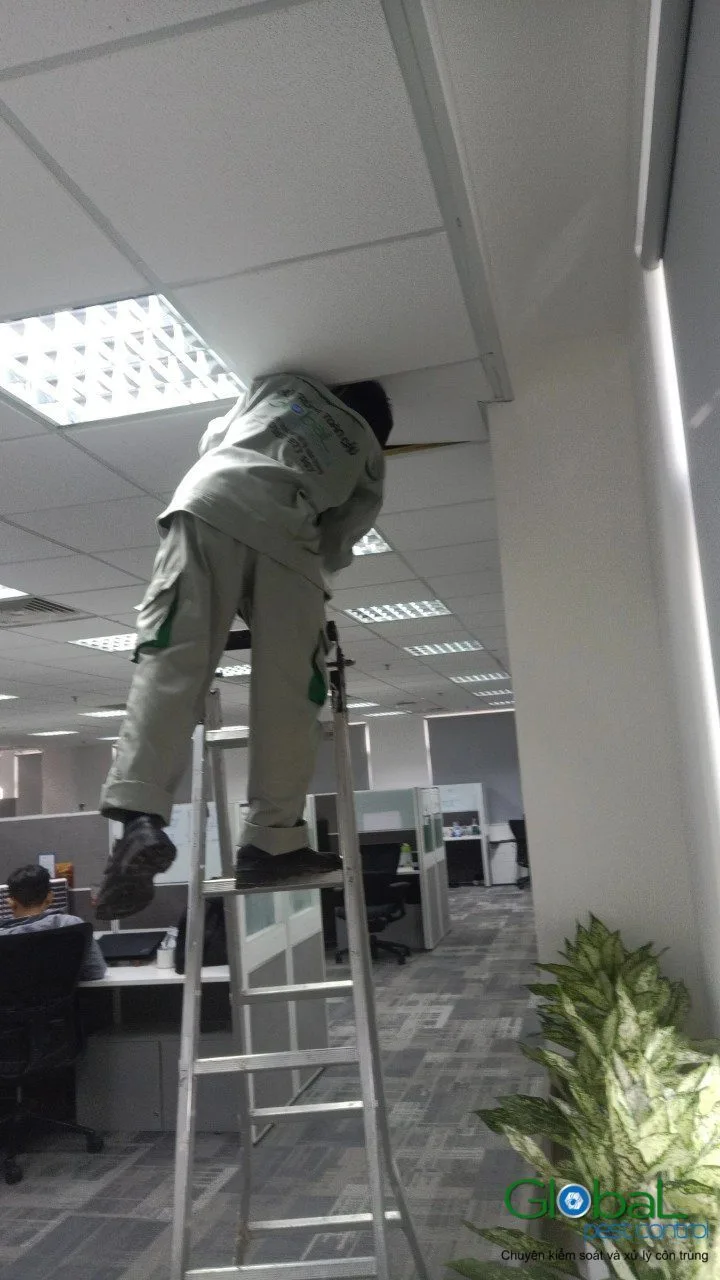
Where a suspended ceiling in the commercial unit is continuous with the structure of the floor above, warmth, steam and odour rise into it and rodents move along it. Extractor ducting through the void adds a permanent warm route.
This is the hardest of the three to address as a resident, because access belongs to the business or the building. It is worth identifying in writing so that the responsibility is clear.
What you can do inside your own unit
- Fill and cover every floor drain that is not in daily use
- Seal around pipe penetrations under the sink and behind the washing machine
- Fit a brush seal or sweep to the gap under the entrance door
- Keep monitoring traps under the sink so you know whether activity is rising or falling
- Do not store cardboard, particularly not under the sink
Raising it with the business or the landlord
Approach it as a shared building issue rather than a complaint about hygiene, because that is usually accurate — a well-run kitchen can still have a drainage stack full of cockroaches. Bring dates, photographs and the species if you know it.
Where a building has several residential units above a food business, a joint approach works far better than individual ones. It also makes a building-wide treatment programme much easier to justify, which is the only thing that resolves a stack problem properly.
What flies indicate, and where they come from
A steady presence of flies in an apartment above a food business almost always traces to waste rather than to the kitchen itself. Bins in a stairwell, a bag left overnight beside a back door, or a drain that is not being flushed will each produce them within a day in warm weather.
Fly problems are the easiest of the three shared issues to solve, because the cause is visible and the fix is a routine change rather than construction work.
Practical protection at the window and door
- Fit screens to any window that opens onto a light well, service yard or the rear of the building
- Fit a brush strip to the base of the entrance door and to any door to a service stair
- Keep balcony and kitchen windows closed during the business's prep and cleaning hours if the extract discharges nearby
- Check the seal around any extract duct passing through your wall
When it is worth moving the conversation up a level
If the drainage stack is the source, no arrangement between you and the business will fix it, because the pipework belongs to the building. That is the point to write to the building owner or management company rather than to the tenant downstairs.
Frame it as maintenance: the stack requires treatment and the gullies require grilles. Framed as a complaint about a neighbour it goes nowhere; framed as a building maintenance item it usually gets scheduled.
Before you sign the lease
If you are considering an apartment above a food business, three checks during the viewing tell you most of what you need. Look at where the bins are kept and whether they are covered. Look at the back stair and the light well for grease and standing water. And look at the floor gullies in the unit itself.
Ask the agent which floor the extract discharges on and whether the building has a pest control contract covering the drainage. A landlord who has thought about it will have an answer; one who has not has told you something useful as well.
Global Pest Control is the English-language arm of Khử Trùng Toàn Cầu. The same technicians and the same programmes are described on the Vietnamese description of our restaurant work.
Book an inspection
Site inspections are free of charge and carry no obligation. A technician walks the property, identifies the species and the harbourage, and sends a written quotation with the method and the schedule — normally within one working day.
Request an inspection · See indicative prices · All services