Service Risers: The Motorway Between Apartments
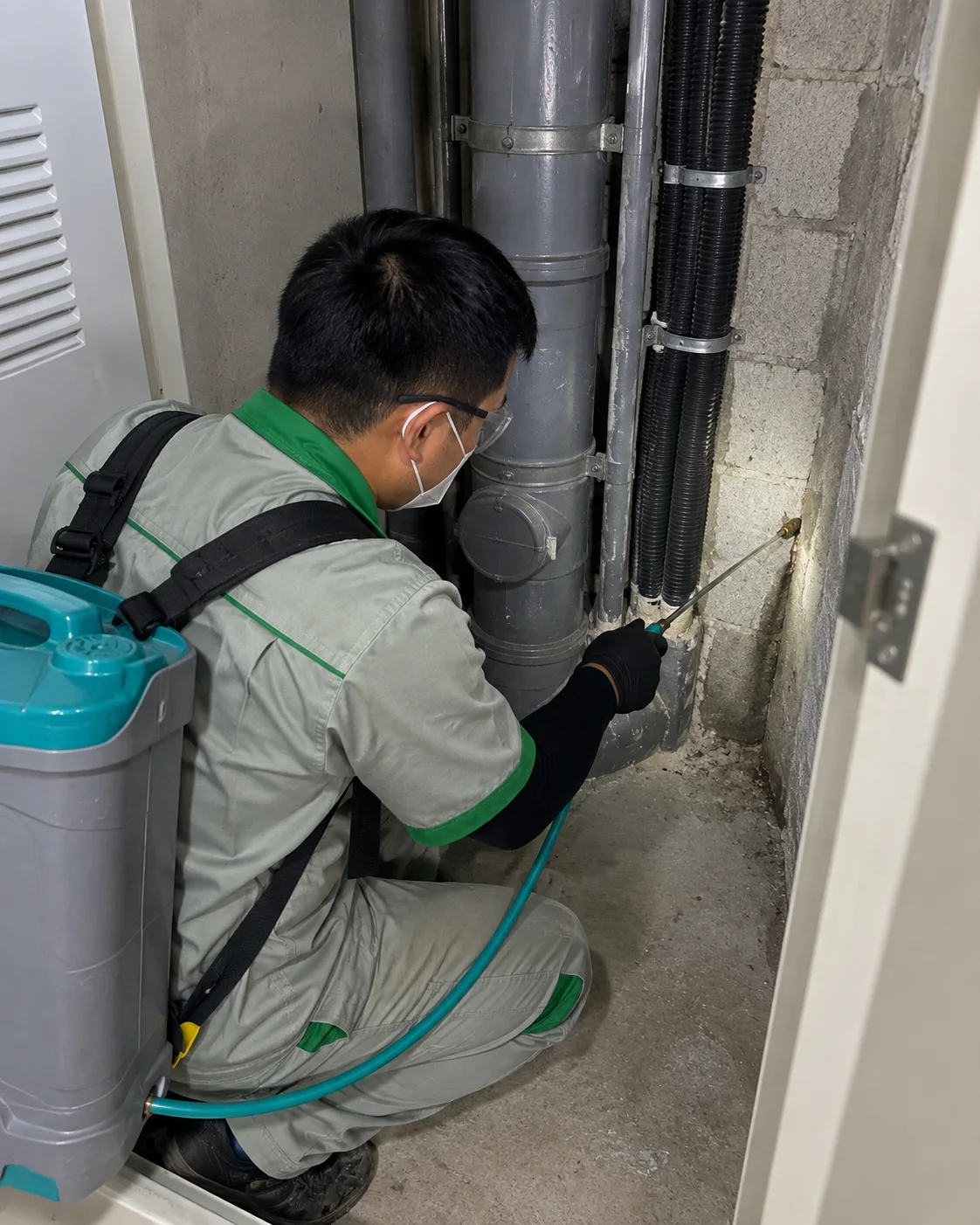
Behind a small locked door on each floor of a Vietnamese apartment building is a shaft carrying water, drainage, power and data from the basement to the roof. It is called hộp kỹ thuật, it is entered perhaps twice a year, and it is the single most important structural feature in building-wide pest problems.
From inside the shaft, the building is not a stack of separate apartments. It is one continuous space with an opening on every floor.
Why it works so well as a route
It is vertical and continuous, warm from the services it carries, dark, undisturbed, and it has an exit at every level where cables and pipes leave the shaft into each tenancy. Those penetrations are made by different trades at different times and are very rarely sealed to a consistent standard.
For a rodent that is a motorway with an off-ramp on every floor. For cockroaches and ants it is a sheltered vertical route between food sources.
The diagnostic pattern
When several apartments on the same vertical line report the same problem and the flats either side report nothing, that is a riser or a drainage stack rather than anything happening inside any of the units.
Conversely, several units on one floor with the units above and below unaffected points at a ceiling void or a corridor route. Establishing which pattern you have is the most useful thing a building can do before commissioning anything.
Why treating one apartment does not hold
A treatment inside a single unit deals with the population inside that unit. If the source is in the shaft, the unit is recolonised as soon as the treatment weakens, which from inside the apartment looks exactly like a failed treatment.
This is the most common reason residents conclude that pest control does not work in their building, and it is also why a good survey asks to see the riser before quoting for the flat.
What to ask the building for
Fire-rated sealing at every floor penetration in the riser. This is usually already a fire compliance requirement, which makes it the easiest budget conversation available — reported as a fire-stopping defect it has an owner and an existing line item, and reported as a pest complaint it goes to whoever handles fogging.
Also: riser doors that close with an intact bottom seal, and the shaft base at basement level treated and monitored, since that is where a rodent population entering the building would start.
The monitoring case
Because nobody enters these shafts, activity is invisible until it is severe. Non-toxic monitors placed at riser landings and at the shaft base give a dated record for very little cost, and they settle the recurring argument between residents and management about where a problem originates.
Three months of clean monitors in a riser is genuine evidence. Three months without a resident complaint is not.
What a resident can do
Seal your own side. The penetrations where pipes and cables enter your apartment from the shaft are within your unit and within your control, and closing them with a hard backing and sealant removes the route into your flat even while the shaft itself remains a problem.
It is not a complete answer and it is the half you can act on this week without anyone\x27s permission.
One detail is worth knowing about how these shafts are used day to day. Contractors installing internet, television or air-conditioning services work in the riser and cut new penetrations as they go, and almost none of them reinstate a seal afterwards because it is not part of the job they were hired for. A building that has had three telecoms upgrades has three generations of unsealed holes, and that is usually the reason a riser that was fire-stopped at handover no longer is.
When the building will not act
Document the pattern rather than the complaint. A message naming four affected units on the same vertical line, with photographs and dates, is a diagnosis that management can act on. Four separate complaints about cockroaches are four items in a log. Where an owners\x27 committee exists, a documented vertical pattern is exactly the kind of evidence it can use.
Related reading
See how buildings here are drained and ceiling voids. The commercial version is cable trays and server rooms. On responsibility, what building management covers and when the building says it is not their problem. Our parent company runs the Vietnamese-language rodent control programme for these buildings.
Global Pest Control is the English-language arm of Khử Trùng Toàn Cầu, based in Thu Duc City.
Common questions
Can I open the riser door on my floor to look?
In most buildings that is management territory and the door is locked, and it is worth asking rather than forcing. What you can do is ask for a joint inspection, which management frequently agrees to when the request is specific and calm. Photographs from that inspection are worth more than any amount of correspondence.
Would sealing the riser make the smell worse in the shaft?
Sealing the floor penetrations does not close the shaft itself, which remains ventilated top to bottom, so it does not trap anything. What it does is separate the shaft from each apartment, which is exactly what fire-stopping is for as well.
We are on the top floor. Are we safer?
Not particularly. Roof rats climb readily and risers run to the roof, so the top floor is at the far end of the route rather than off it. Top floors also have the roof plant, the water tanks and the roof void nearby, which introduces its own set of routes.