False Ceilings and Ceiling Voids in Vietnamese Buildings
Look up in almost any apartment, office or shop in Ho Chi Minh City and you are looking at a plasterboard or mineral tile ceiling suspended below the structural slab. The gap between the two is typically 30 to 60 cm, and it runs the full extent of the floor plate, over the top of every internal partition wall.
From inside, your home has walls. From inside that void, it does not. That single fact explains most of the pest problems people describe as unexplainable.
What is up there
Electrical conduit, data cabling, water supply, sometimes drainage, air-conditioning refrigerant lines and condensate pipes, ducting, and the structural hangers that support the ceiling itself. All of it enters and leaves through penetrations made by different trades at different times, and each penetration is a potential opening into a riser or an adjacent unit.
Also: warmth from the slab, dust, no light, no air movement worth mentioning, and no disturbance at all. It is the most stable environment in the building.
Rats above the ceiling
The most common complaint that leads us into a ceiling void is noise — scratching or running sounds at night, usually described as coming from one corner of a room. Rats use ceiling voids as travel routes precisely because they are continuous and undisturbed, and in older buildings they often nest in the insulation around ducting.
What matters diagnostically is that the noise moves. A stationary noise in one spot is more likely to be nesting; a noise that travels across the room over a few seconds is a run, and a run has two ends that can be found and sealed.
Insects use it differently
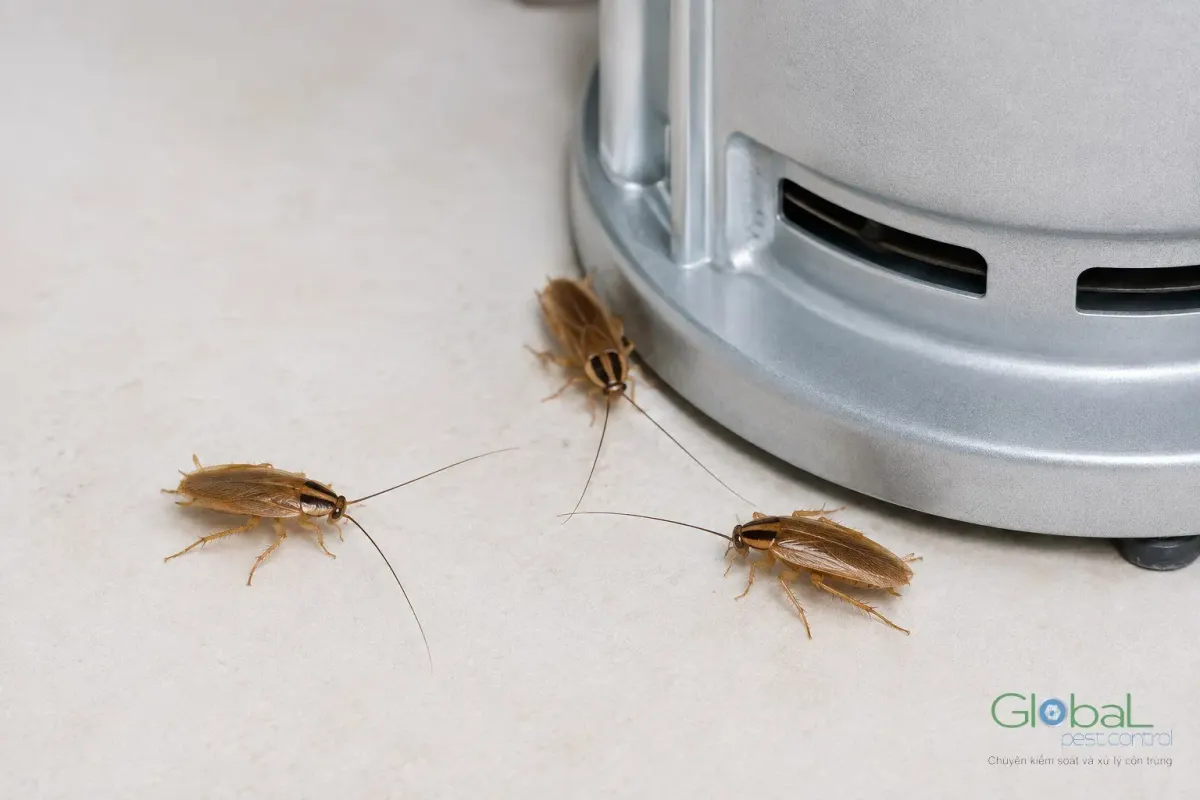
Cockroaches do not travel a ceiling void the way a rat does, but they establish in it, particularly above kitchens and bathrooms where warm moist air rises through light fittings and extract grilles. This is why a kitchen that is treated thoroughly can be reinfested within weeks: the treated area is the visible room, and the population is above it.
Ants nest in ceiling voids readily, often around a pipe with a slow leak, and the trail then appears at a light fitting or a ceiling joint with no visible ground route at all.
How to get access
- Existing access hatches, usually near a bathroom or in a corridor, often painted shut.
- Light fittings and downlights, which can be dropped out to give a torch and camera view.
- Air-conditioning service panels, which are the largest openings in most residential ceilings.
- Mineral tile ceilings, where a tile simply lifts — the easiest of all, and the reason offices are far quicker to survey than apartments.
Why sealing the room does not work
People who discover activity above a ceiling reasonably try to seal the ceiling: fill the gap around a downlight, tape the extract grille, close the hatch. It rarely helps, because the population is not trying to enter the room; it is living in the void and occasionally dropping into the room. Sealing the room stops the sightings and leaves the population in place, and in the case of rodents it simply moves the entry point to the next fitting.
The work that changes things is at the boundary of the void: penetrations into risers, gaps at the external wall, and openings into neighbouring units.
Whose responsibility is it
In a Vietnamese apartment building the ceiling void inside your unit is normally yours, and everything beyond your demising wall is the building. Because the void is continuous, the practical answer is almost always that the building has to be involved, and getting that agreed is often the longest part of the job. Presenting it as a specific request — seal these four penetrations in the riser wall on floor eleven — works considerably better than reporting that there are rats in the ceiling.
Related reading
The vertical route is covered in service risers and the commercial version in cable trays and server rooms. For rodents see our rodent guide and why pests reach high-floor apartments. What the building is responsible for is set out in what building management covers. Our parent company runs the Vietnamese-language rodent control programme for the same buildings.
Global Pest Control is the English-language arm of Khử Trùng Toàn Cầu, based in Thu Duc City.
Common questions
Can you put poison in the ceiling void?
We generally will not, and the reason is practical rather than regulatory. A rodent that dies inside a sealed ceiling void produces a strong odour for two to three weeks in a space you cannot reach, and in an air-conditioned apartment that odour circulates. Trapping with monitored placements, plus sealing the route, avoids that entirely and gives you a body you can remove.
We hear noise but nothing has ever appeared. Is it urgent?
It is worth acting on but it is not an emergency. Noise without sightings usually means a travel route rather than nesting inside your unit, which is easier to resolve and less likely to involve damage. It does mean something is moving freely between your ceiling and somewhere else, and that route will eventually be used by something else too.
Will opening the ceiling make a mess?
Dropping a downlight or lifting a service panel makes almost none. Cutting a new access hatch does make dust, and we would normally suggest putting one in during any renovation rather than as an emergency measure. An apartment with one properly positioned hatch is much cheaper to maintain over a tenancy than one with none.