Laundry Rooms and Utility Areas
In most Ho Chi Minh City apartments the laundry area is a small enclosed balcony or a service corner off the kitchen. It holds the washing machine, a drying rack, a mop bucket, cleaning products and whatever else has nowhere else to go. Nobody spends time in it.
That combination — warmth, permanent moisture, a floor drain, clutter and low disturbance — is unusually complete. Three square metres of it will out-produce a whole living room.
The washing machine is a water feature
A washing machine holds water in its sump and its drain hose between cycles, and the rubber door seal on a front loader stays damp indefinitely if the door is closed. That standing water is a drinking source in a home where nothing else is reliably wet, and the warm motor housing underneath is a sheltered harbourage next to it.
Two habits change this at no cost: leave the door and detergent drawer open between washes, and pull the machine out twice a year to clean the floor under it. The space under a washing machine is the second most productive cockroach harbourage in a Vietnamese apartment after the sink cabinet.
The floor drain again
Almost every Vietnamese laundry area has a floor drain, and it is usually the drain that dries out fastest because the room is used intermittently. A dry floor trap is an open pipe connecting your apartment to the building drainage stack, and American cockroaches use it as a route rather than living in your flat at all.
Pouring half a litre of water down it once a week keeps the seal intact. If the room is genuinely unused for long periods, a silicone one-way drain insert costs very little and removes the problem permanently.
Five things to check in a laundry area
- Under the machine — lint, detergent residue and standing water.
- The floor drain — does it hold water, is the grating seated.
- The drain hose connection, which often drips slowly into a corner nobody sees.
- The mop and cloth store. A damp mop head left in a bucket is a breeding site for small flies.
- Stored cardboard and bags, which are harbourage rather than storage.
Drying racks and mosquitoes
On an enclosed service balcony a drying rack creates still, humid air at exactly the height mosquitoes rest at during the day. It is not a breeding site, but it is a daytime harbourage that keeps a population alive inside the apartment between feeds. Drying with the door to the room open, or running a fan for an hour, disperses it.
Anything on that balcony that holds water — a bucket, a saucer under a plant, a folded tarpaulin, the tray under an outdoor unit — is a breeding site rather than a resting place, and those matter far more.
One detail worth knowing about apartment plumbing here: the laundry drain and the kitchen drain frequently share a stack, and in many buildings they join within a metre of each other. That is why a problem which looks confined to the laundry area often turns out to be the same population that is visiting the kitchen at night.
The clutter question
Laundry areas become the default store for suitcases, tools, spare tiles left by the landlord and boxes that were never unpacked. Each of those is a stable, undisturbed void. You do not need the room to be empty; you need everything in it to be liftable and off the floor, so that the wall-floor junction is visible all the way round.
What treatment looks like in this room
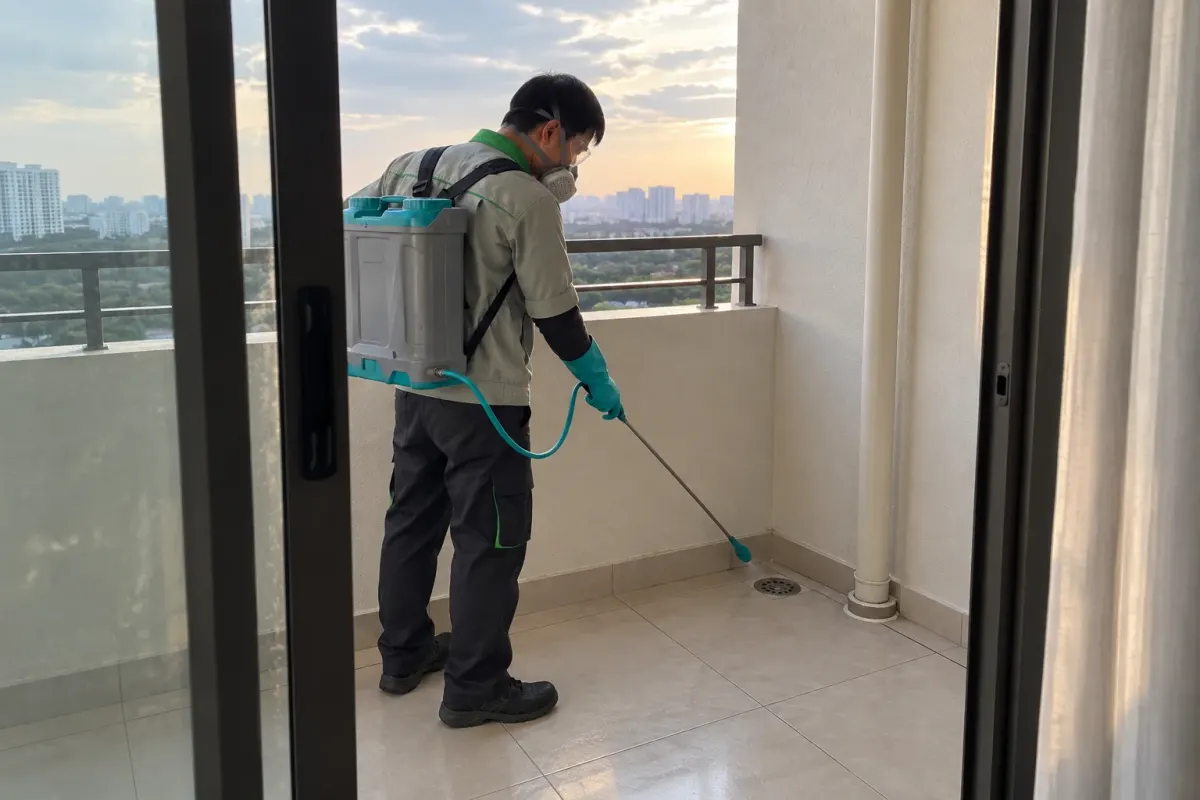
This is a small space with water and food-contact surfaces, so the sensible method is gel bait in the cracks behind and under the machine, dust in structural voids, and a drain treatment where the trap is the route. Spraying an open floor is the least effective option available, and it is the one most commonly used by cheap one-off services because it looks like work.
Related reading
The drain route is set out fully in bathroom floor traps, and the kitchen equivalent in the kitchen sink cabinet. For appliances see what lives behind your refrigerator, and for the balcony, balcony planters. The household programme is our apartment programme. Our parent company covers the same drain and cockroach work in Vietnamese on its cockroach programme for homes.
Global Pest Control is the English-language arm of Khử Trùng Toàn Cầu, working across Thao Dien, An Phu, Phu My Hung and central Ho Chi Minh City.
Common questions
I see large cockroaches only in the laundry area. Why there?
That pattern almost always means they are entering through the floor drain rather than living in your apartment. American cockroaches are drain and sewer animals; German cockroaches live in kitchens. If the sightings are large, brown, fast and confined to one wet room, treat it as an entry problem and check the trap first.
Is a smell from the drain a pest problem?
It is the same problem seen from the other side. A drain that smells is a drain whose water seal has evaporated, which means it is also open as a route. Restoring the seal fixes both, and if the smell returns within a day the trap itself is damaged rather than dry.
Should the washing machine be moved for a treatment?
Yes, and we will move it. Treating a laundry area without moving the machine means treating the accessible half of the room and leaving the productive half untouched, which is why so many of these treatments are reported as having worked for a fortnight.