Fruit Flies, Drain Flies and Phorid Flies Told Apart
Small flies in a kitchen, a bar or a bathroom are one of the most common complaints we handle, and one of the easiest to resolve once the species is right — because each of the three breeds somewhere specific.
Treating the room does nothing in any of the three cases. Finding and removing the breeding site resolves all of them, usually within days.
Fruit flies
Two to four millimetres, tan or brown, often with distinctly red eyes, hovering around fruit bowls, bins, drink dispensers and bar areas.
They breed in fermenting organic material: over-ripe fruit, the residue in a bottle or a can, a drip tray, a mop bucket, the film inside a beer line drain. The cycle takes about a week here, which is why a fruit bowl left over a holiday produces a population.
Drain flies
Also called moth flies. Two millimetres, dark, distinctly fuzzy, with broad rounded wings held roof-like over the body. They rest on walls near drains and fly weakly in short hops rather than hovering.
They breed exclusively in the organic film lining drains, gullies, grease traps and any permanently wet organic surface. Their presence is a reliable indication of drain film rather than of anything on the surfaces of the room.
Phorid flies
Two to three millimetres, humpbacked in profile, and the giveaway is behaviour: they run rapidly across a surface in short erratic bursts rather than flying away, which is why they are sometimes called scuttle flies.
These are the most significant of the three, because they breed in decaying organic matter that is often out of sight — a broken drain beneath a floor slab, a dead rodent in a void, sewage-contaminated soil, or organic sludge under equipment.
Why phorids matter more
A persistent phorid population in a food business frequently means a structural problem: a cracked drain under the floor, a leaking waste pipe in a wall, or contaminated substrate beneath a slab. They can breed in material several centimetres underground and emerge through a crack in tiling.
That is also why phorids are a serious audit finding. An auditor who sees them will ask about drainage integrity rather than about cleaning, and they will be right to.
Finding the source
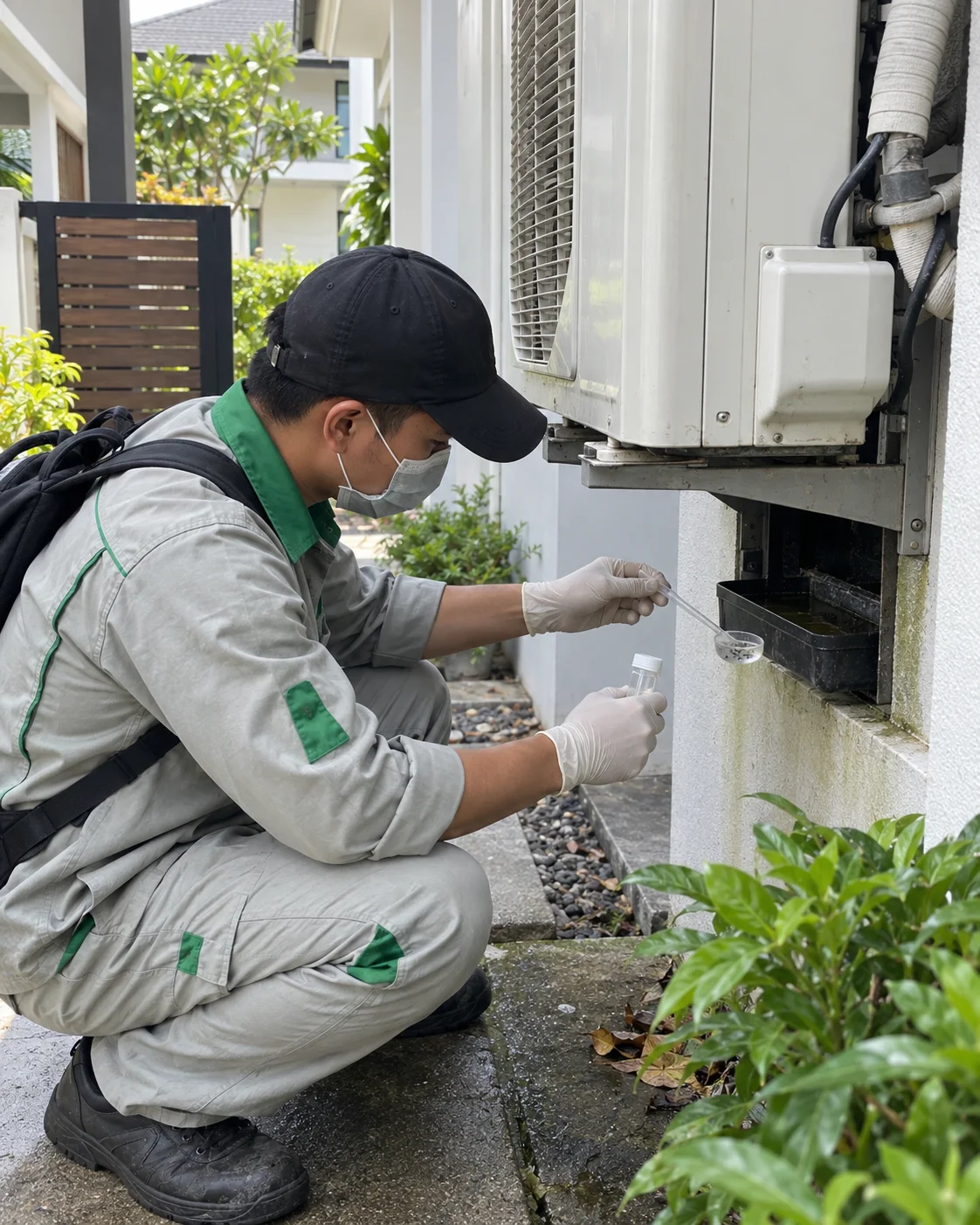
The tape test works well for drains: cover the drain opening with clear tape, sticky side down, leaving a small gap for airflow, and check the following morning. Flies emerging from that drain will be stuck to the tape, which identifies which of several drains is producing.
For fruit flies, work through the obvious candidates in order — fruit, bins, bottles, drip trays, mop buckets, the base of a drinks dispenser — and remember that a single forgotten item can support a whole population.
What resolves each
Fruit flies: remove the source, and the population collapses within days without any treatment. Drain flies: mechanical cleaning of the drain to break the film, then a bio-enzymatic or foaming product applied to coat the pipe wall above the water line.
Phorid flies: find the structural source. That may mean lifting tiles, camera inspection of a drain, or checking a void for a carcass. It is the only one of the three where treatment without finding the source is guaranteed to fail.
One more distinction is worth making because it changes who you call. House flies and blowflies are larger, breed in exposed waste and carcasses rather than in drains, and are usually a waste management question. The three small species above are all about something wet and organic that is out of sight, which is why they persist in kitchens that look immaculate.
Why insecticide is the wrong first move
Spraying kills the adults in the room and does nothing to the larvae in the substrate, so numbers return within days. Every one of these three species has a short generation time, which means a treatment aimed at adults is competing with continuous replacement. Source removal is not the cheap option here; it is the only one that works.
Related reading
See our fly guide and drain treatment. For commercial settings, grease traps and bar areas and drip trays. Building drainage is covered in how buildings here are drained. Our parent company runs the Vietnamese-language fly control programme.
Global Pest Control is the English-language arm of Khử Trùng Toàn Cầu, based in Thu Duc City.
Common questions
We cleaned everything and they are still here. What now?
Then the source is somewhere you have not looked, and the usual candidates are a drain, a drip tray under equipment, or something beneath a floor. Do the tape test on every drain in the area, and check under and behind any equipment that has not been moved. In a commercial kitchen, the drain under a piece of fixed equipment is the classic answer.
Do those vinegar traps work?
They catch adult fruit flies and are a reasonable indicator of where activity is concentrated, which makes them useful for locating a source. They do not reduce a population meaningfully, because the larvae in the substrate continue developing. Use one as a diagnostic rather than as a control.
Are they a health risk?
Drain and phorid flies move between drainage or decaying material and food surfaces, which makes them a genuine contamination concern in a food business rather than only a nuisance. Fruit flies are less significant in that respect. In all three cases the presence indicates a hygiene or structural condition worth resolving on its own merits.