April: The Month the Termites Fly
Every year, on the evening of one of the first heavy rains, thousands of winged insects appear around lights across the city. They fly badly, they shed their wings on windowsills and floors, and by morning there are small piles of discarded wings.
This is a termite nuptial flight, and it is the single most misread event in the Vietnamese pest calendar. People treat it as an invasion. It is an announcement.
What the flight actually is
A mature termite colony produces winged reproductives, called alates, once it has reached sufficient size — which takes several years. Warmth, humidity and a drop in barometric pressure trigger the flight, which is why it coincides with the first significant rains.
They leave, pair up, shed their wings and attempt to found new colonies. The overwhelming majority fail. So the swarm you see is not a colony arriving; it is evidence that a mature colony exists somewhere within flight range and has existed for years.

Telling termites from flying ants
- Waist. Termites have a broad, straight body with no narrow waist. Ants have a pronounced pinch.
- Wings. Termites have four wings of equal length, longer than the body. Ants have larger front wings and smaller rear ones.
- Antennae. Termites have straight, beaded antennae. Ants have elbowed antennae.
- What is left behind. Piles of shed wings of equal size on a windowsill is a termite signature.
This matters because the response is entirely different. Flying ants are a nuisance for an evening. Termites mean an inspection.
The question that actually matters
Not how many flew, but where they came from. If the alates emerged from inside your building — from a wall, a door frame, a skirting, a ceiling — you have a colony in the structure. If they flew in through an open window toward a light, the colony is outside and could be anywhere within a few hundred metres.
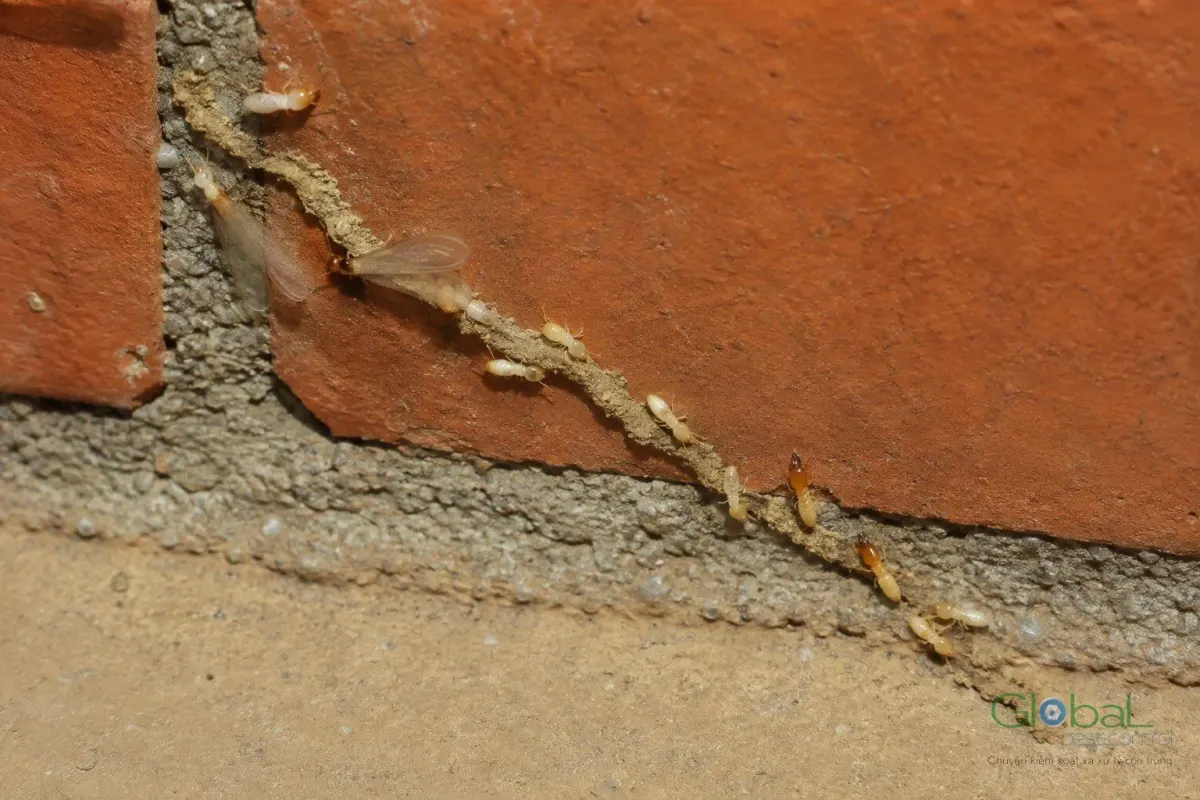
The distinguishing observation is the exit point. Alates emerging indoors leave through a small hole, often with a scatter of wings directly beneath it and sometimes a temporary mud structure around it. That spot is worth photographing and not disturbing.
What to do that evening
Turn off outside lights and close windows on the side of the building where they are concentrated, which reduces how many enter. Do not spray them — they are harmless, they will die within hours, and an aerosol tells you nothing while making the room unpleasant.
Collect a few in a container or photograph them clearly. Sweep and keep the shed wings, noting where they were. That information is genuinely useful the next day and impossible to reconstruct later.
What to look for the next morning
Mud tubes on foundation walls, on the outside of a plinth, on a garden wall or running up a pillar — pencil-width earthen tunnels that termites build to travel under cover. Wood that sounds hollow when tapped but looks intact. Paint or plaster that has a blistered or rippled appearance. Door frames and skirting boards at ground floor level.
None of these appear overnight, which is the point. They have been developing while the colony matured, and the flight is simply the first thing anybody noticed.
There is one more reason to take the flight seriously rather than sweeping it up. Alates are attracted to light, so a swarm concentrating at one window on one side of a building often points roughly toward where the colony sits. That is a weak signal on its own and a useful one alongside a ground-level inspection the following morning.
Why this matters more for houses than apartments
Subterranean termites enter buildings from soil, so ground-contact property — houses, villas, shophouses, ground-floor units — carries most of the risk. High-floor apartments are largely immune to subterranean species, though drywood termites in furniture are a separate and much less common issue that can occur anywhere.
Related reading
See termite swarms after the first rains and mud tubes. Species detail is in subterranean and drywood termites and our termite guide. For timing, March preparation. Our parent company covers termites in Vietnamese at its termite programme for homes.
Global Pest Control is the English-language arm of Khử Trùng Toàn Cầu, based in Thu Duc City.
Common questions
They flew in and now they are gone. Do I still need an inspection?
If they came in through a window from outside, and there is no evidence indoors, then not urgently — though for a ground-contact property it remains worth doing at some point. If they emerged from inside the building, yes, promptly. The exit point is the deciding observation, which is why it is worth looking for it that night rather than the following week.
Can I treat termites myself?
Realistically no, and attempts usually make the job harder. Repellent products applied to a visible tube divert the colony to another route into the same building and remove the evidence a technician would use to trace it. Modern practice uses non-repellent products and baiting systems that transfer through the colony, which needs the colony located first.
How long does a colony take to reach swarming size?
Commonly three to five years for a subterranean colony, sometimes longer. That is why a swarm is never an early warning — it is a mature colony announcing itself. Buildings that have been swarmed near for several consecutive years without an inspection are worth checking regardless of whether damage is visible.