Bed Bug Evidence: What Counts and What Does Not
Almost every bed bug enquiry begins with bites, and bites are the weakest evidence available. Reactions vary enormously, many other things bite, and a significant proportion of people show no reaction at all.
What confirms bed bugs is physical evidence on the furniture, and it is all findable with a torch in about ten minutes if you know the four things to look for and the four places to look.
One: faecal spotting
The most reliable and most common sign. Dark brown or black spots, one to two millimetres, which are digested blood. On fabric they soak in slightly and have a diffuse edge; on a hard surface they sit as a raised dot.
The distinguishing test is a damp white cloth: a bed bug spot smears reddish-brown, because it is blood. A cockroach speck or a piece of dirt does not. That test settles the question in seconds and is worth doing before calling anybody.
Two: shed skins
Bed bugs moult five times as they develop, leaving a translucent amber husk with the shape of the insect intact. Finding these is strong evidence of a breeding population rather than a single introduced individual, because moulting means development is happening on site.
Three: eggs
About one millimetre, pearly white, slightly elongated, glued into crevices in small groups. They are hard to see without magnification and a good torch, and they are usually found in the same locations as the spotting rather than separately.
Four: live insects
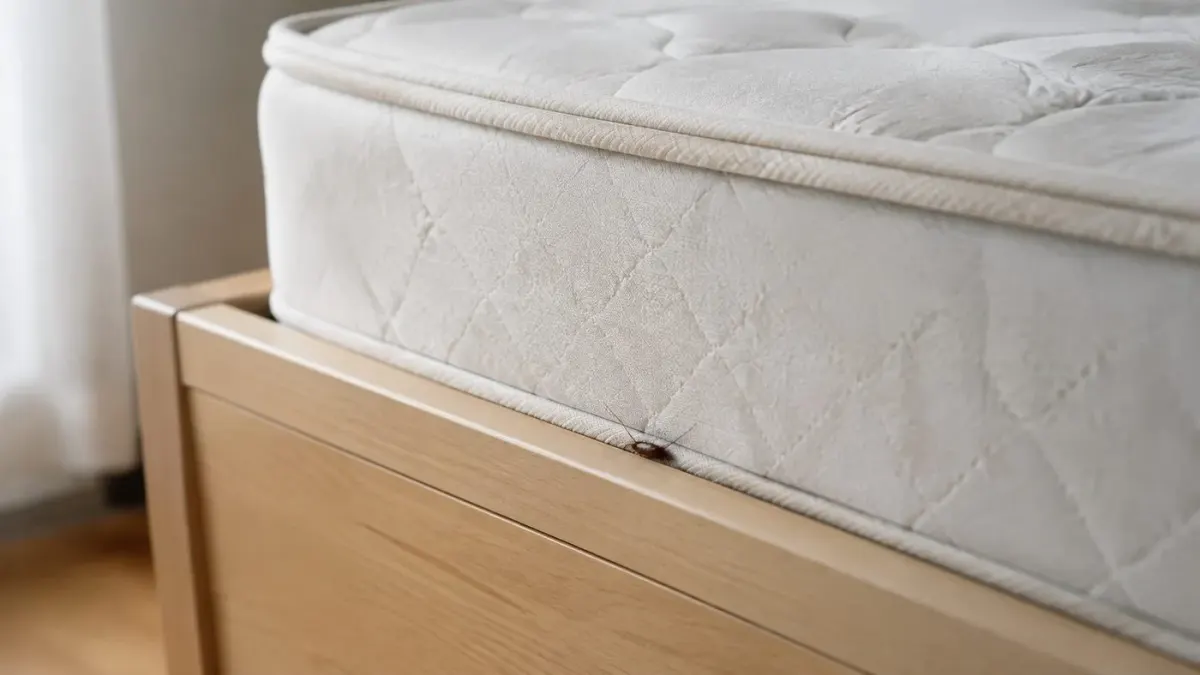
Adults are about 5 mm, flat, oval and reddish-brown, becoming rounder and darker after feeding. Nymphs are smaller and translucent, and are easy to miss entirely.
Seeing a live insect is definitive and it is also the least likely of the four, because the population spends the overwhelming majority of its time in harbourage. A search that finds nothing alive has not ruled anything out.
Where to look, in order
The headboard first, particularly where it meets the wall and inside any fixing recess. In the properties we survey here, evidence appears behind the headboard more often than on the mattress, because a headboard is fixed, dark, undisturbed and close to a sleeping person.
Then the mattress seams on all four sides including the label corner; then the bed frame joint where the base meets the side rail; then the bedside table drawer runner and its underside. Those four cover the great majority of findings.
What is not evidence
Bites in a line or a cluster, which is folklore rather than diagnosis. A single unidentified insect, which is more often a carpet beetle, a booklouse or a bat bug. An itchy night. A smell, since the often-described sweet musty odour is only detectable with a heavy infestation and is not something to rely on.
And a negative search is not evidence of absence, particularly early on when a population may be a handful of insects in one crevice.
What to do when you find something
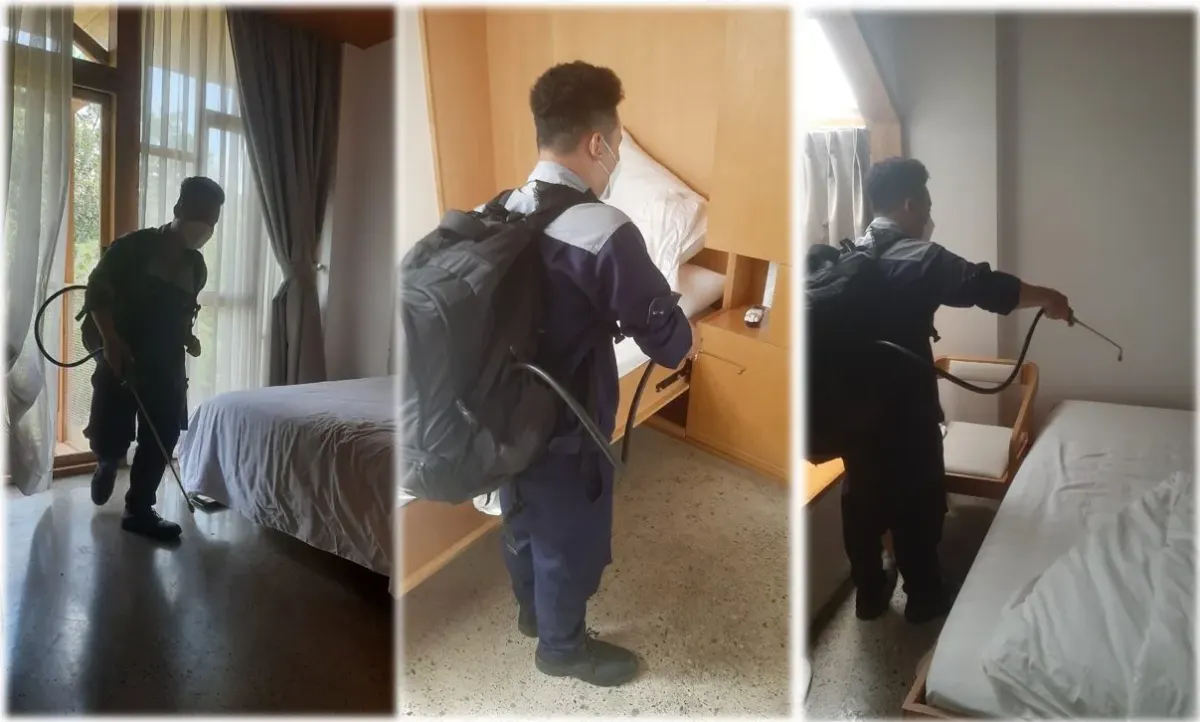
Stop and leave the room as it is. Do not strip the bed, do not move furniture out of the room, do not spray. All three spread the problem into the rest of the property, and a repellent aerosol in particular will scatter a localised population through several rooms.
Photograph what you found in place. Close the door. Then call. A problem confined to one room is a straightforward job; the same problem spread by well-intentioned cleaning is not.
Why the follow-up visit exists
Eggs are considerably more resistant to insecticide than adults and nymphs, so eggs present on the day of treatment hatch afterwards. A second visit at ten to fourteen days is a requirement rather than an upsell, and a quotation that omits it is quoting a partial job.
Related reading
See bed bugs in Ho Chi Minh City and bites that are not bed bugs. For hotels, the six-point room check and guest room turnover. On method, heat treatment. Our parent company runs the Vietnamese-language bed bug treatment service.
Global Pest Control is the English-language arm of Khử Trùng Toàn Cầu, based in Thu Duc City.
Common questions
I have bites but I cannot find anything. What now?
That is common early on, and the honest answer is that a search finding nothing does not rule it out. Two things help: interceptor cups placed under the bed legs, which catch insects travelling to and from the bed and give a dated result over a week or two, and considering the alternatives — mosquitoes, fleas, mites and skin conditions all produce similar marks.
Should I throw out the mattress?
Almost never, and it frequently makes things worse. A mattress can be treated and encased, and removing it through a building without sealing it spreads the problem along the corridor and into the lift. Where a mattress is genuinely beyond saving, it should be sealed in plastic in the room before it is moved.
Can I sleep in another room until it is treated?
Understandable and usually the wrong move. Bed bugs follow the host, so moving to the sofa or a spare room typically extends the infestation into a second room. Staying in the same bed until treatment is unpleasant and it keeps the problem contained, which shortens the job considerably.