Talking to Building Management About a Pest Problem
The building management office — ban quản lý — handles everything from parking cards to lift maintenance, in Vietnamese, with a queue. A pest complaint arriving as a general expression of frustration goes into a log. A pest complaint arriving as a specific, located, evidenced maintenance request gets a work order.
The difference is not persistence. It is the shape of what you send.
The three features of a request that works
- A location. Floor, unit, and the specific place — "the riser cupboard on floor 11 beside apartment 03", not "our floor".
- A photograph. One image of the defect or the evidence removes most of the language problem and all of the ambiguity.
- A named defect rather than a symptom. "The refuse room door does not close" is actionable. "There are cockroaches" is not.
Reframing a pest problem as a maintenance defect
This is the single most useful move available to you. Most building-side pest problems have a physical cause that already belongs to somebody: a door seal, an unmeshed tank overflow, an unsealed riser penetration, a blocked drain, a broken bin lid.
Each of those has an existing budget, an existing contractor and an existing obligation. Reported as a pest issue it goes to whoever handles pest complaints, which may be a monthly fogging contract that will not help. Reported as a defect it goes to maintenance and gets fixed.
What is genuinely the building\x27s responsibility
Common areas, the refuse room and chute, basements and car parks, service risers and shafts, external drainage, water tanks, landscaping, and the building fabric outside your demised unit. In practice this covers the origin of most cockroach and rodent problems in a tower, because those populations live in shared structure rather than in individual flats.
Inside your apartment is generally yours, or your landlord\x27s, depending on the lease.
Writing it in Vietnamese
A short bilingual message works better than either language alone, because it can be forwarded internally without translation. Something in the shape of: Kính gửi Ban quản lý, tại tầng 11 gần căn hộ 03 có mùi hôi và gián từ cống. Nhờ Ban quản lý kiểm tra giúp. Xin cảm ơn. — To the management board, on floor 11 near apartment 03 there is a smell and cockroaches from the drain, please inspect.
Attach the photograph. Keep it to three sentences.
Escalating without becoming the difficult resident
If nothing happens in a fortnight, follow up on the same message thread rather than starting a new one, so there is a visible history. If nothing happens after that, raise it with the resident committee or the owners\x27 committee where one exists, which in Vietnamese buildings often carries more weight with the operator than an individual resident does.
What rarely works is escalating in tone. What does work is escalating in specificity: a dated list of three previous messages and a photograph of the same defect still present.
Timing helps as well. Management offices in Vietnamese towers are busiest at the start and end of the day, and a message sent mid-morning tends to be read rather than queued. If the matter is at all complicated, going to the office in person once with the photograph printed is worth more than three messages, because it puts a face to the unit number.
When several residents have the same problem
A problem reported by one flat is a flat\x27s problem. The same problem reported by four flats on the same stack is a building problem, and it is treated differently. If neighbours are experiencing it too, a single message listing the affected units is far more effective than four separate complaints, and it also tells management something diagnostically useful — a vertical pattern points at a riser, a horizontal one at a floor.
Related reading
Responsibility is set out in what building management covers, and the awkward case in when the building says it is not their problem. For the physical causes see service risers and refuse rooms and chutes. The vocabulary is in our glossary. Our parent company works directly with Vietnamese building operators through its commercial programme.
Global Pest Control is the English-language arm of Khử Trùng Toàn Cầu. We will write to a building management office in Vietnamese on your behalf, with our findings attached.
Common questions
The building fogs monthly and it does not help. What should I say?
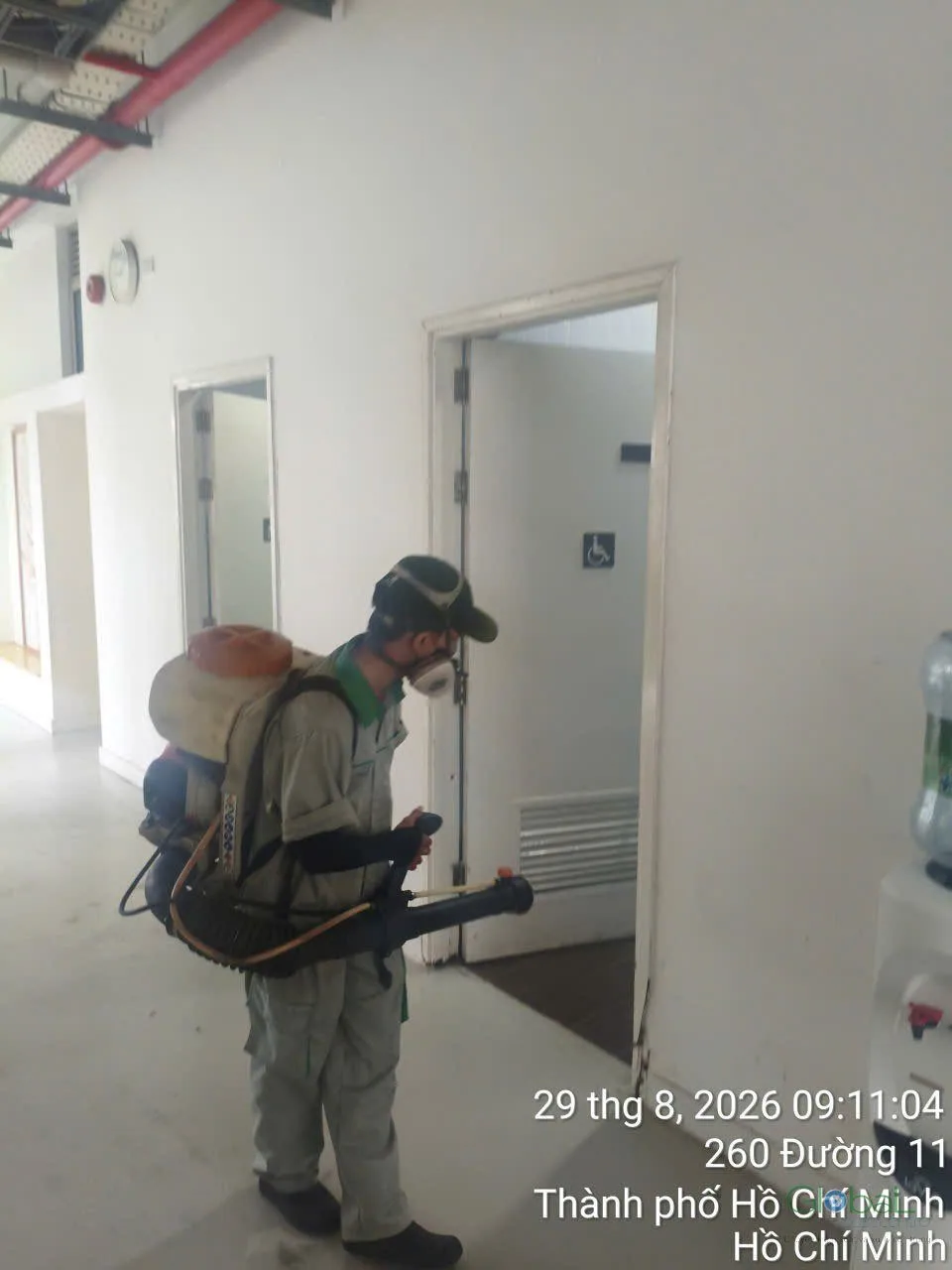
That fogging kills adult insects present at that moment and has almost no residual effect, so anything breeding in a drain, a tank or a riser produces a new generation within days. The constructive version of the message is not that fogging is useless but that it treats the symptom, and that the source needs finding — which is a survey request rather than a complaint.
Can I get my own contractor to treat the common areas?
Not without the building\x27s consent, and they will normally decline because the areas are theirs and there are liability questions. What you can do is have your own unit surveyed and send the findings to management, which frequently achieves more than the complaint did, because it hands them a diagnosis rather than a problem.
Should I write in English or Vietnamese?
Both, in the same message, with Vietnamese first. It can then be forwarded internally without anyone having to translate it, which removes the most common reason a message stalls. Keep the Vietnamese short and simple rather than elaborate.