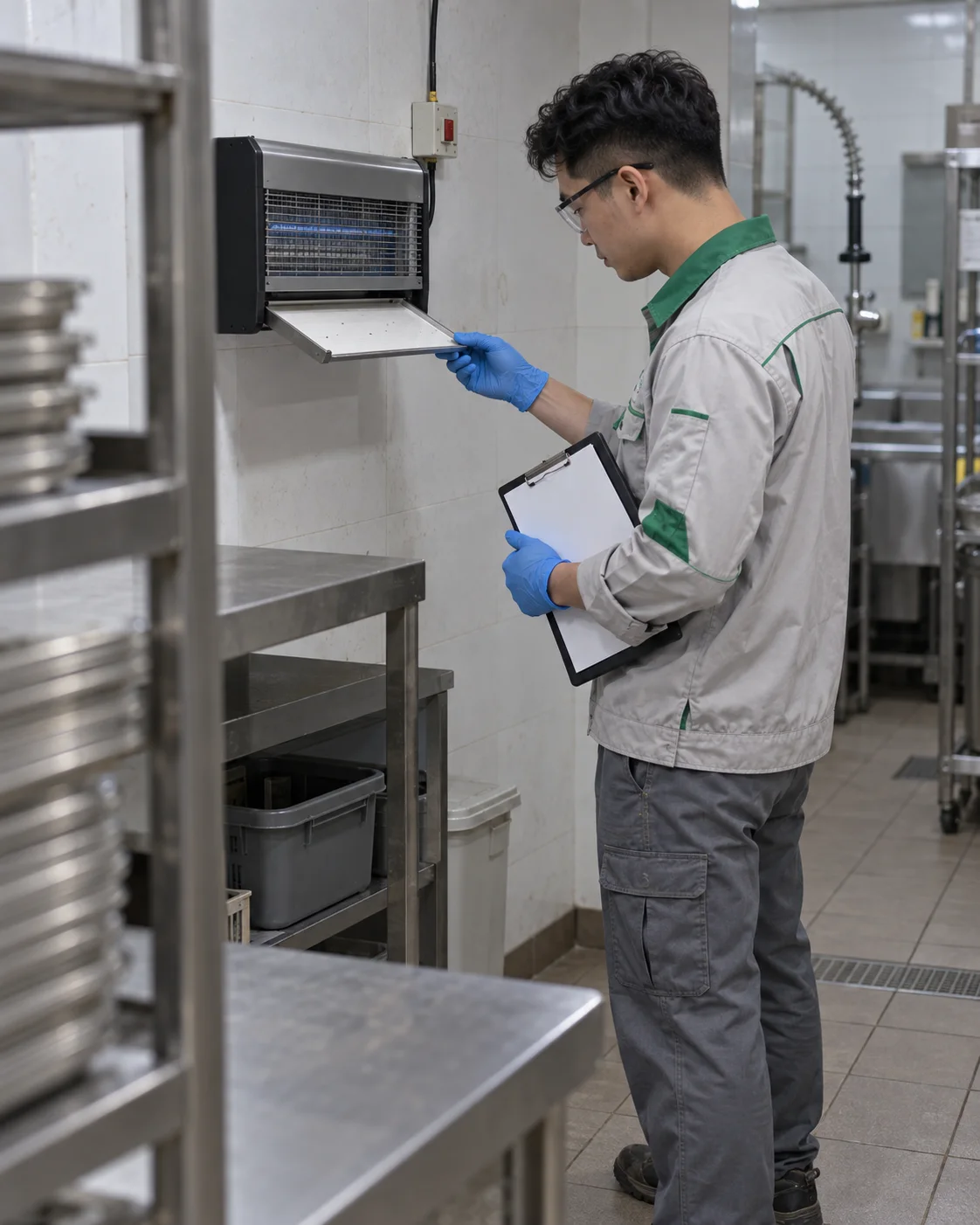
Dry Stores and Stored Product Pests in a Kitchen
Almost every insect problem in a kitchen can be treated. Stored product pests are the exception, and understanding why saves operators a great deal of money spent on the wrong thing.
They live inside the sack. The larvae develop within the flour, the rice, the nuts or the dried fruit, and no product applied to a shelf, a wall or a floor reaches them. The only controls that work are stock control and disposal.
What they are and what they look like
Indian meal moth is the commonest here: a small moth about 8 mm with a two-tone wing, seen flying at head height in the late afternoon. Its larvae spin fine webbing, and webbing in the corner of a sack or under a lid is usually the first sign. Flour and grain beetles are 3–4 mm, reddish-brown, and move fast when a sack is opened. Rice weevils are similar but with a distinct snout, and they leave small round exit holes in individual grains.
All three tolerate the temperature of a Vietnamese dry store comfortably, and all three complete a generation in four to six weeks in this climate — roughly twice as fast as in a temperate country.
They arrive on a delivery, almost always
This is the single most useful fact about them. Infestation on site is rare; infestation delivered in a carton is normal. Product is packed, stored in a warehouse and transported at ambient temperature, and eggs already inside the packaging hatch on your shelf rather than on the supplier's. By the time you see moths flying, the source carton has often already been broken down and used.
That is why goods-in inspection is the control point rather than the store itself. Opening a representative sack from each delivery of flour, rice, nuts, pulses and dried fruit takes two minutes and catches the problem at the door.
The physical set-up that limits damage
- Shelving 150 mm off the floor and 50 mm off the wall, so the space behind and beneath can be seen and swept.
- Open product decanted into sealed containers with the date written on. A rolled-down paper sack is not sealed.
- Strict rotation. The sack at the back that has been there eight months is where it starts.
- No cardboard on the floor. Corrugated board is both a harbourage and a sign that stock control has slipped.
- Pheromone monitors for moths, placed at head height and dated. They tell you the trend rather than the fact.
What to do when you find them
Dispose of the infested product. Not treat it, not sift it, not use it up quickly — dispose of it, in a sealed bag, out of the building. Then empty the shelf completely, vacuum the shelf edges and the wall behind, and pay particular attention to the corner joints and the underside of shelf lips, where pupae attach. Only then is it worth applying anything, and what is applied is a light residual to the empty shelving and the wall junction, never to product.
Any contractor who offers to spray your flour store without asking you to empty it first is selling a visit rather than a result.
What to say to the supplier
Keep the packaging and the batch code. Both are what make a supplier conversation productive rather than an argument, because they let the supplier check the same batch elsewhere. Identifying the species also tells you something: a rice weevil in rice points squarely at the supply chain, while an Indian meal moth in an eight-month-old open sack of nuts points at your own rotation. An honest technician will tell you which of the two you have.
Where else in the building they turn up
Dry stores are not the only place. Pet food, decorative dried flowers, birdseed, and the flour used in a bakery all support the same species, and in a mixed-use building an infestation in a retail unit downstairs can supply moths to an office pantry above it. If moths appear in a room with no dry goods at all, look upward and downward before looking harder in the room. See pest control for supermarkets and food retail.
Related reading
For the goods-in procedure in detail see the factory and warehouse programme. For the kitchen programme around it, see the restaurant programme and cafés and bakeries. Records are covered in the food safety audit file.
Global Pest Control is the English-language arm of Khử Trùng Toàn Cầu. Identification and reporting in English; supplier and waste conversations in Vietnamese. Vietnamese-language services are at khutrungtoancau.vn.
Common questions
Can we freeze the product instead of throwing it away?
Freezing at −18 °C for seven days does kill all life stages, and for a small quantity of expensive product it is a legitimate option. For bulk flour or rice in a commercial kitchen it is rarely practical, and the freezer space is usually worth more than the product.
Is the food safe if we sieve the insects out?
It is not a food safety emergency, but it is a quality and reputation problem, and in a commercial setting it is not defensible if a customer finds one. For a business the answer is disposal. For a household, sieving and using the product is a personal choice most people decline once they know what the webbing is.
How do we prove it came from the supplier?
Keep the packaging, the batch code and the delivery note, and photograph the product in situ before you disturb it. A dated identification report naming the species adds weight. Together those turn a disagreement into a traceable batch question, which is what a supplier can actually act on.