Choosing a Kindergarten: Pest Questions Worth Asking
Parents touring a kindergarten in Ho Chi Minh City ask about curriculum, staff ratios and lunch. Almost nobody asks about pest management, which is a shame, because the answer reveals how a school handles routine risk generally — and because it is one of the few areas where a bad answer is easy to recognise even if you know nothing about the subject.
These are the four questions worth asking, and what a reassuring reply actually sounds like.
One: who does your pest control and how often do they come?
A good answer names a company, states a frequency, and mentions that reports are kept. A weak answer is "we spray during the holidays" or "the building takes care of it". Both of those are common and neither is wrong in itself, but both mean nobody at the school is holding the file.
The building taking care of it is genuinely fine for a kindergarten inside an office tower, provided somebody at the school can tell you who to ask. If nobody can, the honest reading is that it has never been checked.
Two: what do you use in rooms where the children are?
This is the question that separates schools that have thought about it from schools that have not. The reassuring answer is specific and narrow: bait inside closed voids, dust in structural gaps, monitors, and nothing applied to accessible surfaces while children are on site.
The answer to be wary of is "it is completely safe, do not worry". No product is meaningfully described that way, and a school repeating a contractor\x27s sales line has not asked the question itself.
Three: when do you do the bigger work?
Schools have an advantage no other food-serving site has: long empty periods. A well-run kindergarten does deep cleaning behind equipment, drain work, proofing and anything with a re-entry period during term breaks, and can tell you so without checking.
A school that does everything on a Wednesday evening is doing a weaker version of the same job, usually because nobody has planned the year.
Four: what happens if a child comes home with bites?
You are listening for a process rather than a promise. Something like: the room is inspected, the family is contacted directly, and the finding is written down whether or not anything is found. Schools that answer this well have had it happen before and learned from it.
Schools that treat the question as an accusation are telling you how the conversation would go if it were ever your child.
What to look at while you are walking round
- The bin area and the kitchen door — lidded bins, a door that closes, no bags on the ground outside.
- The nappy change and milk preparation areas, and whether the units can be moved for cleaning.
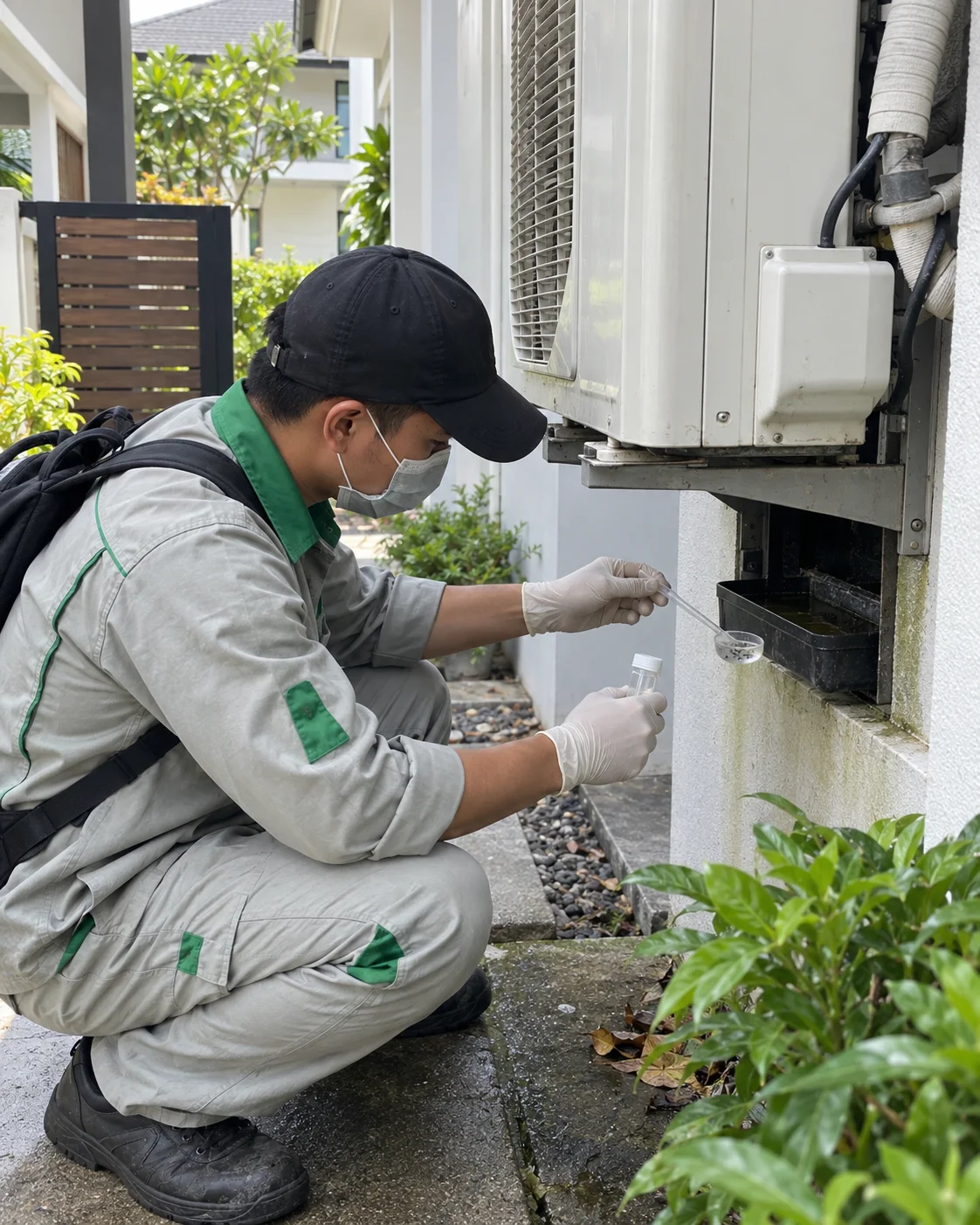
- Outdoor play areas after rain — standing water in tyres, sandpit covers, planters and drainage channels.
- Window screens and door gaps in the classrooms themselves.
What is not a red flag
Seeing a monitor trap tucked behind a cupboard is a good sign, not a bad one — it means somebody is measuring. Ants in an outdoor play area in Vietnam are normal and are not evidence of neglect. A school that says it had a cockroach problem last year, dealt with it, and now monitors monthly is more trustworthy than one that claims never to have had anything.
What should concern you is an aerosol can on a classroom shelf, a bait station within a child\x27s reach, or a school that cannot produce any record at all.
Asking without becoming the difficult parent
These questions land better on a tour than in an email after enrolment, and they land better still framed as curiosity rather than inspection. "How do you handle pest control here — I ask because we are coming from a country with a very different climate" is a question a school will answer openly. It is also true, which helps.
Related reading
The technical detail is in rooms used by children under three and school canteens and food service areas. For safety generally see safety with children and pets, and for the record a school should hold, what should be kept on file. The programme itself is our school and nursery programme. Our parent company runs the Vietnamese-language school programme.
Global Pest Control is the English-language arm of Khử Trùng Toàn Cầu, based in Thu Duc City. We report to international schools in English and brief their Vietnamese kitchen teams in Vietnamese.
Common questions
Is it reasonable to ask to see the pest control reports?
Entirely, and a well-run school will show you without hesitation because the file is one of the things they are proud of. If a school declines, the reason is almost always that no file exists rather than that it contains anything alarming.
Should I worry if I see ants in the playground?
No. Outdoor ants are part of the environment in southern Vietnam and eliminating them from a garden is neither possible nor desirable. What matters is whether they are trailing into food areas indoors, which is a different question with a specific answer.
My child has come home with bites. What should I ask the school?
Ask where the child sleeps or rests, when the room was last inspected, and whether anything similar has been reported by other families this term. Bites have many causes and mosquitoes are far more likely than anything else in this city, so the useful move is to establish the pattern before anyone reaches a conclusion.